

Programme
| 15:00 – 18:00 | Guided tours of the building and our high-tech laboratories |
| Presentations: | |
| 16:00 – 16:10 | HWN Tulln |
| 16:10 – 16:20 | Bachelor’s degree programme in Biotechnical Processes |
| 16:20 – 16:30 | Bachelor’s degree programme in Biomedical Science in Tulln |
| 16:30 – 16:40 | Bachelor’s degree programme in Software Engineering & Digital Systems Development |
| 16:40 – 16:50 | Master’s programme in Bio Data Science |
| 16:50 – 17:00 | Master’s programme in Biotechnology & Analytics |
| 17:00 – 17:10 | HWN Tulln |
Our study programmes at HWN Tulln
Biomedical Science
Biotechnical Processes
Software Engineering and Digital Systems Development
Biotechnology & Analytics
in Bio Data Science*
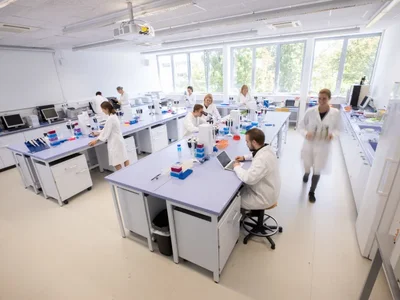
Come and visit our high-tech laboratories!
-
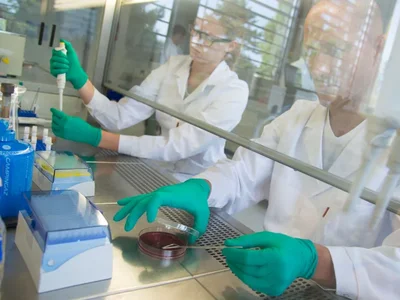
Molecular biology
In the molecular biology laboratory, you will learn how cell culture systems are used in cancer research, how diagnostic tools are developed, and how microorganisms produce new active substances.
-
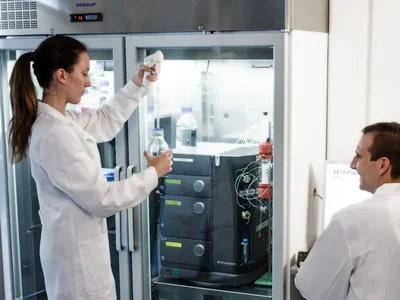
Biochemical Methods and Protein Analysis
Whether enzymes, mediators of the immune response or biomarkers – proteins are involved in all physiological processes. The purification, analysis and characterisation of these biomolecules are therefore of great importance. We demonstrate how these methods are taught in a practical way on the Master’s programme in Biotechnology & Analytics.
-
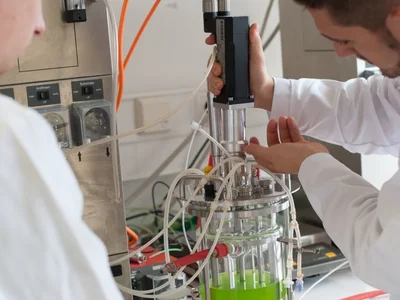
From media optimisation to the fermentation of a recombinant microorganism
Media optimisation is carried out in shake flasks using statistical experimental design. The fermenter undergoes batch, fed-batch and production phases to produce a recombinant protein.
-
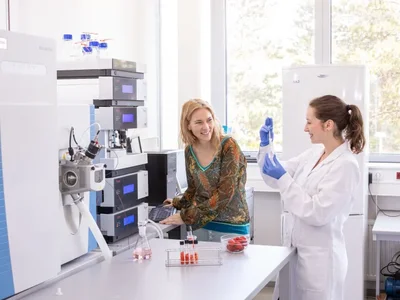
Mass spectrometry
Whether it’s life sciences, the environment, medicine or space exploration – modern mass spectrometers provide answers to many questions. You’ll be surprised at just what’s possible in this field, both on our Master’s programme and beyond.
-
Textile recycling
Textile recycling is one of the key issues for achieving climate neutrality, as set out by the EU in the Green Deal. Find out how textiles can be kept in a circular economy and what biotechnological processes Wiener Neustadt University of Applied Sciences is developing to achieve this.
-
Environmental biotechnology
Using state-of-the-art environmental biotechnology methods, environmental toxins are detected, environmental risk assessments are carried out, and solutions to soil contamination are developed.
-
Data to combat antibiotic resistance
Antibiotic resistance is a growing global problem. In our interactive demo, we show how Bio Data Science helps us to understand biological data and develop new solutions – from the analysis of microbial communities to AI-assisted prediction of protein structures. What used to take months can now be calculated in seconds. These methods are key tools in modern life sciences.
-
Spectroscopy
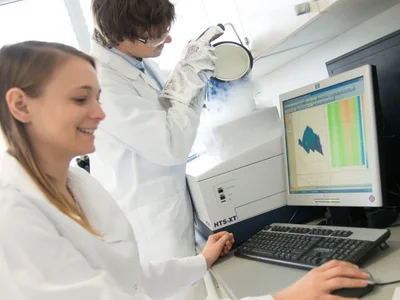
Optical spectroscopy can be used to monitor or control biotechnological processes and to characterise a wide variety of biological samples. Bioinformatic data analysis, including statistical modelling and experimental design, is employed to systematically and comprehensively examine the results obtained.
-
© HWN -
© HWN -
© HWN -
© HWN -
© HWN -
© HWN -
© HWN


