


Study with me:
Agricultural Technology & Digital Farming
Bachelor Agricultural Technology and Digital Farming
This degree programme is taught in German.
Agriculture meets cutting-edge technology: the Agricultural Technology degree programme at HWN (formerly FHWN) combines crop production, animal husbandry and agricultural engineering with Informatics, AI and robotics – a programme unique in Austria. Using experimental fields, modern machinery and the Innovation Farm, you’ll work with the latest developments in agriculture and agricultural engineering. You’ll study from Monday to Wednesday, whilst Thursdays and Fridays are free for farm work or a job.

Start where your questions begin.
Key facts about the degree programme
Content-
Academic degree
Bachelor of Science in Engineering (BSc)
-
Duration
6 semesters (180 ECTS)
-
Organisation
full-time
-
Location
HWN Wieselburg - Francisco Josephinum
-
Language
German
-
Start
27.09.2027
-
Application date
05.10.2026 - 15.06.2027
-
Places available
25
Study schedule & fees.
Monday–Wednesday, 7.30 am–8.00 pm | mainly face-to-face | no classes on Thursday and Friday
Detailed study plan for the Bachelor’s degree programme
ContentHere’s what you can expect on the Bachelor’s degree programme in Agricultural Technology & Digital Farming
The Bachelor’s degree in Agricultural Technology combines a solid grounding in agricultural sciences with technical and digital skills. You will learn how sensor technology, artificial intelligence and digital systems contribute to more precise decision-making, simpler workflows and more efficient production processes in agriculture. The first few semesters lay the agricultural foundations, after which you will specialise in Informatics, mechatronics, geoinformatics and AI – always with a direct link to agricultural practice. You will apply what you have learnt directly during project weeks and an 10-week internship.
-
Crop Production and Soil Science
You will learn about the factors that influence the growth of agricultural crops – from soil and fertilisation to crop rotation – and use this knowledge to determine appropriate crop management practices. You will also learn out in the field, where you can directly observe the crops and the effects of your practices.
-
Livestock farming and animal health
You will familiarise yourself with housing systems, feeding and animal health, and gain an understanding of how animal welfare can be measured, documented and improved.
-
Agricultural machinery, from tractors to attachments
You will learn about the machinery, equipment and processes used in agricultural production, from soil preparation through to sowing, cultivation and harvesting.
-
Measurement and Sensor Technology with a Laboratory Session
You’ll gain hands-on experience with the sensors used today in machinery, drones and livestock housing. You’ll understand how data is generated, how reliable it is, and how to use it to make decisions on the farm.
-
Mechatronic Systems and Agro-Mechatronics
You’ll learn how sensor technology, electronics and mechanics work together in modern agricultural machinery, from GPS-controlled tractors through to ISOBUS and retrofit solutions, right up to field robots.
-
Geoinformatics and Computational Intelligence
You’ll be working with geospatial data, application maps and AI methods, ranging from plant identification and fertiliser optimisation to automated livestock monitoring in the barn.
-
Programming and Software Application Development
You will learn structured programming, work with algorithms and data structures, and put your own software solutions into practice using modern development tools.
-
Smart Farming
You will learn how to deploy machinery in a site-specific manner, apply forecasting models and use data from machinery, drones and satellites to inform decisions in the field and in the barn. Here, you will combine agricultural knowledge and digital technologies directly in a practical context.
-
Business Administration and Management
You will learn how to run a farm profitably and how the use of new technologies pays off. You will also learn about strategic business management, data-driven decision-making, risk assessment and putting your own business ideas into practice.
-
Ethics, Communication and Law
Animal welfare, ethical issues and agricultural communication are just as much a part of modern agriculture as technology. You’ll also learn about the legal framework, ranging from agricultural law and farm succession to the AI Act.
The Curriculum & the Course Descriptions
1. Semester
Course
ECTS
- Agricultural Engineering 1
- English (E)
- Principles of Business Management
- Agricultural Practice
- Livestock Farming
- Crop Production
- Physics
- Accounting
- Self-Management & Time-Management
- Principles of Agricultural Production Seminar
2. Semester
Course
ECTS
- Agricultural Engineering 2
- Applied Chemistry
- Applied Mathematics 1
- Applied Mathematics 1 (Tutorial)
- Soil Science and Crop Management in Crop Production
- English for Engineering 1 (E)
- Electrical Engineering (Basics)
- Cost Planning and Controlling
- Programming, Algorithms and Data Structures 1
- Academic Work and Research
3. Semester
Course
ECTS
- Agricultural Biology & Organic Farming
- Applied Mathematics 2
- Applied Mathematics 2 Tutorial
- Applied Statistics
- English for Engineering 2 (E)
- Measurement- and Sensor-Technology
- Measurement- and Sensor-Technology (Laboratory Tutorial)
- Programming, Algorithms and Data Structures 2
- Computer Architecture and Networks
- Process Engineering in Agricultural Production
4. Semester
Course
ECTS
- Computational Intelligence
- Database Systems
- Ethics in Agriculture
- Geoinformatics
- IT Security
- Mechatronic Systems
- Mechatronic Systems (Laboratory Tutorial)
- Object-Oriented Programming
- Quality Management and Project Management
- Legal Issues in Agricultural Engineering
- Software Application Development 1
5. Semester
Course
ECTS
- Agricultural Mechatronics
- Current Issues in Austrian Agriculture
- Communication & Presentation
- Production Economics
- Project Weeks
- Smart Farming Seminar
- Smart Farming
- Software Application Development 2
6. Semester
Course
ECTS
- Bachelor Thesis Seminar
- Internship
- Corporate Management
Good to know: If you have prior agricultural (e.g. HBLA) or technical (e.g. HTL) qualifications, you can have individual courses recognised for credit. This means you can combine the first semester with your basic military service, and you can start your degree in the same year as your Matura.
What additional qualifications the Bachelor’s degree programme offers you
Your qualification is recognised as advanced specialist training in agriculture and forestry. This is a real advantage for future farm successors and farm managers: You will gain a qualification similar to that of a skilled agricultural worker – which would otherwise require a separate specialist training programme – and can therefore apply for the young farmer’s settlement grant and the plant protection competence certificate.
Data Protection Officer
In the agricultural sector, an ever-increasing amount of farm- and person-related data is being generated, ranging from machine data to livestock records. With this certification, you can take on the role of data protection officer within a company or farm.
EXIN Agile Scrum
You will learn about agile working in a team, a method that is standard practice in software and technology projects. This complements the content covered in software application development by introducing the appropriate way of working.
ISOBUS programming
In a dedicated workshop, you will learn how to programme control units to the ISOBUS standard, covering everything from the basics through to more advanced topics and practical application. This will give you a thorough understanding of the very interface through which the tractor and implement communicate with one another.
Hunting course and hunting examination
You can take the course and sit the exam whilst you are studying. The only costs involved are the exam fees.
pma/IPMA® Project Management Certification
As a student at Wiener Neustadt University of Applied Sciences, you can obtain an internationally recognised pma/IPMA® project management certification in addition to your degree – recognised proof of project management competence and a clear advantage for any applicant. The certification is an optional extra offered as an elective module. The HWN offers a dedicated preparation course to help you prepare specifically for the exam. You’ll sit the certification exam at pma (Projekt Management Austria). As HWN is a corporate member of pma, you’ll benefit from a reduced fee.
Tractor, forklift and drone licences
You can obtain one or more of these licences. With a drone licence, you are permitted to fly agricultural drones yourself, such as those used in the remote sensing course at the experimental field.
An insight into the study programme
-
-
Agricultural Technology Meets
Remote Sensing -
What is a degree programme that combines agriculture and digital technology like?
-
What the ground reveals
-
Sowing for the Future – Soil Meets Innovation
-
Because of the combination of agricultural and digital skills, this degree programme was the right choice for me. I’m taking a lot of what I’ve learnt back to my family farm, and it’s important to have technically skilled practitioners in our agricultural sector.
-
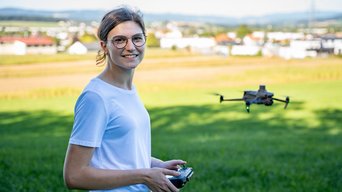
Here, I can build on the agricultural expertise I have already acquired and explore promising areas of agriculture. That is what appealed to me about this degree programme.
-
I decided to take this course because I want to deepen my technical knowledge in the field of agriculture, and I will find the agricultural qualification very useful when I take over my parents’ farm as a part-time business.
-
It’s brilliant to gain new insights into agricultural machinery. The potential of this sector is far from being fully realised!


How much practical experience is involved in an agricultural technology degree?
On the Bachelor’s degree programme in Agricultural Technology & Digital Farming, you’ll gain practical experience directly in the field, in livestock housing and at companies within the sector. This career-enabling degree programme, which runs from Monday to Wednesday, leaves you free on Thursdays and Fridays – giving you time to work on your own or your parents’ farm, take part in the working student programme, or undertake an internship. This allows you to build up a professional network whilst still studying and gain an insight into day-to-day working life before you even graduate with your Bachelor’s degree.
Practical highlights of the programme:
Site visits and practice classes
In the immediate vicinity of the campus, a state-of-the-art field trial facility is available to you in partnership with Josephinum Research, featuring numerous field trials and innovative technology. You will make use of it during field visits and practice classes.
Practice classes in the lecture theatre and the laboratory
You’ll be working in the Mechatronics and Precision Farming Laboratory on tractor and implement terminals, agricultural drones or small robotic solutions, and you’ll gain an understanding of how they’re used in practice. Thanks to the direct link to the machinery hall and the trial fields, you’ll be able to put what you’ve learnt into practice straight away. In the field of artificial intelligence, too, you’ll work with real-world data and examples from the agricultural sector – on your own laptop, if you wish.
Project weeks
As part of a team, you will work on specific, practical tasks that you propose yourself, or that arise from current research projects or partner organisations.
Compulsory work placement in the 6th semester
You will undertake a 10-week internship (12 ECTS) at a company or organisation of your choice, often linked directly to your bachelor's thesis.
Excursions, field days and industry events
Field trips to research and industry partners, visits to agricultural and agricultural machinery trade fairs, as well as field days at home and abroad, and events such as the Winter Conference will give you an insight into the agricultural and agricultural machinery sector. In the process, you’ll establish early contacts with potential employers.
Working Student
On Thursdays and Fridays, you can work at a company in your field or use the days to help out on your own farm. In partnership with companies in the sector, the study programme offers you optional, tailor-made job opportunities that can be combined with your studies. As a working student, you’ll gain professional experience in your field whilst building a network that will make it easier for you to start your career.
Previous positions have been offered by companies such as FiveSquare, Farm-ING Smart Farm Equipment, TERRA Innovation OG and Österreichische Hagelversicherung. The positions change annually, and information on current vacancies is provided regularly.
Clinical and collaborative partners
During your degree, you’ll collaborate with companies and research organisations in the agricultural and agricultural engineering sector – through project weeks, internships, field trips and the working student programme. They contribute project briefs to the project weeks, provide equipment for practice classes and offer work placement and working student positions.












Application and admissions to the Bachelor’s degree programme
ContentHere’s how to apply as an applicant!
Would you like to apply to study Agricultural Technology & Digital Farming at the Wieselburg Francisco Josephinum site? Here you can find out what entry requirements you need to meet, how the admissions process works and what documents you’ll need. You can apply online via our application portal. If you have any questions about the degree programme or your application, either before or during the application process, Jennifer Frank will be happy to help.
You can find the current application deadlines at the top of the ‘Key Facts’ section under ‘Programme structure, application deadlines & costs’.
Applications & Admissions
To be admitted to the bachelor’s programme in Agricultural Technology & Digital Farming, you must meet one of the following entry requirements:
- An Austrian school-leaving certificate (Matura) or a vocational school-leaving certificate, or
- An equivalent foreign qualification, or
- A relevant university entrance qualification examination, or
- A relevant vocational qualification with an additional qualification
A background in agriculture or a technical field is not essential, but is an advantage. You may submit your final certificate by the end of October.
Application Process & Admissions Procedure
You can apply online via the application portal. You can register using your email address or log in using ID Austria. The application portal will guide you through the application process and you can check the status of your application at any time.
Submit your application
Log in to the application portal, complete your application and upload the required documents. With ID Austria, any data already available can be imported, so you only need to add any missing details and documents.
Good to know: You can apply even before you’ve finished school and submit any missing documents later. You don’t have to complete your application in one go: your entries are saved, so you can pause at any time, continue later and amend your details before finally submitting.
Checking your documents
We’ll check whether you meet the entry requirements and whether your documents are complete. If any documents are missing, you can submit them via the application portal.
Personal admissions interview
There is no traditional entrance examination. If you meet the entry requirements, we will invite you to a personal admissions interview. During this interview, we would like to get to know you, your background to date and your motivation for studying the course. Of course, you will also have the opportunity to ask any questions you may have.
Admission decision
Once the admissions process is complete, you will receive the decision by email and via the application portal.
Offer & Start of Studies
Once you have been offered a place, you will sign your educational agreement online via the application portal and pay the tuition fees and the ÖH contribution for the first semester.
Documents required for the application
You will usually need the following documents for your application:
Proof of your entry requirements (e.g. A-level or vocational qualification certificate)
CV
Photograph
Proof of identity (passport or identity card)
- Proof of German language proficiency, if applicable
- Miscellaneous certificates or documents
Tip: You can also log in to the application portal using ID Austria. This allows any data already on file to be imported, which makes your application easier.
You can see exactly which documents you need to upload directly in the application portal. You can submit any missing documents later if necessary.
Options for crediting
Have you already completed a vocational training programme or achieved academic credits? Whether these can be recognised towards your degree will be assessed on a case-by-case basis. There is no automatic recognition of credits.
If you have relevant agricultural (e.g. HBLA) or technical (e.g. HTL) prior learning, you have a good chance of having credits recognised. You can submit an application to this effect at the start of your degree programme.
Did you complete your degree abroad?
If you obtained your school or university qualification abroad, additional requirements may apply to your application to HWN.
You should therefore find out well in advance about the language and subject-specific entry requirements for your chosen study programme, as well as the current entry and residence regulations in Austria. Please also note that translations and certified copies of your documents may be required.
Important: Your foreign academic qualifications will only be assessed on a case-by-case basis once you have submitted your application and – if required – paid the deposit in accordance with Section 4(5a) of the Foreigners Act (FHG). It is not possible to carry out a preliminary assessment of your documents. Further information on the costs involved can be found in our Tuition Fees and Charges Regulations in the Download Centre.
Please note: For applicants from third countries who require a visa or a residence permit, the earlier application deadline at the end of March applies. If this does not apply to you, we nevertheless recommend that you submit your application by the end of March at the latest to allow sufficient time for your documents to be assessed. However, the application deadlines for your chosen study programme also apply.
For the Bachelor’s degree programme in Agricultural Technology & Digital Farming, you will also need German language skills at C1 level and English language skills at B1 level. You must submit the relevant evidence of these skills with your application.
Place of study
ContentYour degree programme at the HWN Wieselburg Francisco Josephinum site
You’ll be studying at Weinzierl Castle in Wieselburg – an agricultural hub with a long tradition, which is now regarded as a centre of excellence for digital agriculture. Here, you’ll study in modern, well-equipped lecture theatres, with a canteen and sports facilities right on site. Practical and hands-on sessions take place at the Josephinum Research site: in the measurement and mechatronics laboratory, in the machinery hall with tractors and equipment, and on the trial fields.
Outside of your studies, Wieselburg in Lower Austria’s Mostviertel region offers landscapes perfect for walking and cycling, sports facilities and an outdoor swimming pool, as well as concerts, restaurants and bars to wind down after a day’s study.

Your career after graduation
ContentWorking as an Agricultural Technology & Digital Farming Expert
With a Bachelor’s degree in Agricultural Technology & Digital Farming, you’ll gain the qualifications needed for a diverse sector: agriculture is becoming digital, connected and data-driven – and this requires specialists who understand both worlds. You’ll work at the interface between the field, the farmyard and modern technology, and apply this knowledge in business, research or your own farm. The combination of agricultural expertise and digital skills is in high demand throughout the sector.
What you work on in your day-to-day work
In your day-to-day work, you’ll be working on things such as:
- managing and strategically developing your own business.
- advising agricultural businesses or providing agricultural services.
- selecting, implementing and further developing smart farming solutions for fields, livestock housing and machinery.
- analysing data from livestock housing sensors, drones, satellites or machinery and using it to inform decisions in livestock management or in the field, for example regarding soil preparation, sowing, fertilisation or crop protection.
- Develop mechatronic systems and software solutions for livestock housing and agricultural machinery.
- Implement retrofit solutions for existing machinery and equipment and automate workflows.
- Further develop, market or service products in the agricultural and farm machinery sector.
- Applying AI models to agricultural applications, such as monitoring the health of livestock or optimising field operations.
- Streamline administrative processes using IT and AI solutions.
What jobs await you after your bachelor’s degree
Depending on your interests, a wide range of career paths are open to you, from running your own farm or your parents’ farm, through the agricultural and agricultural machinery industries and technical sales, to consultancy, research and setting up your own business.
Typical career paths include:
- Farm manager / farm successor
- Inter-farm service provider in agriculture
- Developer in the agricultural and agricultural machinery industry
- Project manager for smart farming and agricultural projects
- Product manager for agricultural and farm machinery solutions
- Key Account Manager for smart farming technologies
- Service and sales staff members
- Agricultural adviser at a Chamber of Agriculture or in cooperatives
- Staff member at trade associations and interest groups
- Researcher / Research and Development Staff Member
- Innovation Manager for agricultural digitalisation projects
- Data Analyst specialising in agricultural data
- Entrepreneur in the agricultural and technology sectors
Research & Infrastructure in the Bachelor’s programme
ContentYour research site: from the laboratory to the trial field
Many practical sessions, practice classes and courses take place directly at the research site. Through programme-specific innovation projects and the research carried out by Josephinum Research, you’ll gain access whilst still studying to the very technologies that will shape the agriculture of tomorrow. The resources you’ll have at your disposal are virtually unrivalled at any other university.
-
Precision Farming and Mechatronics Laboratory
You will be working with electronic measurement equipment, 3D printers, mobile robots and programmable tractor terminals from leading manufacturers, including virtual equipment demonstrators.
-
Machinery hall and trial fields
Right next to them are tractors fitted with GNSS, ISOBUS and telematics systems, as well as machinery for soil preparation, sowing, fertilisation and crop protection, and RTK surveying equipment.
-
Agricultural drones and remote sensing
Using multi-spectral and hyperspectral cameras and a DJI dock, you will plan, fly and analyse automated drone flights over the trial fields.
-
Innovation Farm
This is where market-ready technologies are tested and evaluated under real-world operating conditions. You’ll have access to field robots, semi-autonomous vehicles and electric tractors, which are otherwise only available in small numbers.
-
AI research in agriculture
International projects such as AgrifoodTEF bring AI and robotics solutions directly into the curriculum. These are complemented by datasets, simulation environments and machine learning pipelines.
-
Academics from the research sector
Our lecturers are themselves involved in ongoing research projects and incorporate the latest technologies and methods directly into their courses.
Projects & Real-world Accounts
-
Attachments,
which control the tractorThe projects come from leading companies in the sector and are not simulated but actually carried out – ranging from methods of plant fertilisation and the distribution accuracy of fertiliser spreaders to systems that protect wildlife from mowers. Many students also complete their internship in the sixth semester at the Innovation Farm and write their bachelor's thesis there. The project is supported by the federal government, the federal states and the European Union.
-
The agricultural sector is looking for experts who understand and can apply agricultural processes and technologies. The Innovation Farm is the ideal environment for this.
-
Test Centre for
Agricultural RoboticsCompanies and start-ups test their AI and robotics solutions here before they go into mass production: in field trials, on machine test benches or virtually, by testing algorithms against existing datasets. For you, this means access to infrastructure that is otherwise rarely available to universities. Several lecturers are involved in the network; national project management is led by Peter Riegler-Nurscher, who also teaches Computational Intelligence and Measurement & Sensor Technology.
-
Agricultural data often reveals opportunities for optimisation. Digitalisation therefore presents an opportunity for professionalisation, even within Austria’s small-scale agricultural sector.
-
The blind spot of autonomous machines
Until now, this monitoring has been carried out by humans. Without it, true autonomy remains impossible, as anomalies occur constantly, particularly in mechanical weed control and mowing techniques. To address this, the AI models combine data from various sources – camera images, videos and laser scans. The training dataset is being made freely available for the first time. Students are contributing to these developments as part of the research teams led by Markus Gansberger, Peter Riegler-Nurscher and Georg Linsberger.
-
IT skills are essential for modern agriculture, where sensor-controlled machinery is used. Fertilisation tailored to actual needs and targeted crop protection save on inputs and help to protect the environment.
-
How the cow
is really doingThe focus was on measuring pressure in the dorsal rumen: can this provide an indication of how a cow’s forestomach moves? Based on this description, a system was developed for the continuous measurement of contractions. It was developed in collaboration with smaXtec, a company that manufactures sensor technology for early detection in animal health, reproduction and feed management.
-
New technologies in the field of artificial intelligence are laying the foundations for more efficient use of resources and a high degree of automation. Driven by data, they will fundamentally transform agriculture.


Award-winning in the 2026 Agricultural University Rankings
In the 2026 agricultural university ranking by top agrar and Karrero, around 1,700 students from Germany, Austria and Switzerland assessed their universities. The Bachelor’s degree programme in Agricultural Technology & Digital Farming achieved five top-three placings across eight categories, including two first places: for the best teaching in the field of agricultural engineering and for the core subjects. It came second in the categories of plant sciences, teaching staff and organic farming.
96 per cent of the students surveyed would recommend the university to others. And 65 per cent of them come from a farming background themselves; the average across all participating universities of applied sciences is 55 per cent.

Awards for bachelor's theses and final-year dissertations
Outstanding student work is publicly recognised within the study programme through two annual awards. These awards are presented to bachelor's theses by students and final projects by school leavers that address issues relating to agricultural technology.
Endowed Chair in ‘Data-Centric AI in Agriculture’
With the endowed chair in ‘Data-Centric AI in Agriculture’, the Francisco Josephinum is systematically expanding its research into artificial intelligence in agriculture. The focus is on how agricultural data is processed and made usable for AI applications in the field and in livestock housing. The findings are incorporated directly into teaching.
The content does not necessarily reflect the views of the Province of Lower Austria or the Lower Austrian Research Promotion Agency as the funding body. Neither the Province of Lower Austria nor the funding body can therefore be held responsible for the content.

Contact & personal advice
Content
To make sure no questions remain unanswered, please feel free to contact us!
-
Dipl.-Ing. Dr. rer. nat. Markus Gansberger, BEd Bakk. techn.
head of programme
-
Contact details for prospective students


Frequently Asked Questions and Answers
What does ‘Agricultural Technology & Digital Farming’ actually mean?
Modern agriculture can hardly function without digital technology these days: tractors, drones and livestock housing systems are equipped with sensors, GPS and IoT (Internet of Things) solutions. This enables fields to be managed in a targeted manner, vital signs of animals to be monitored in real time, and work processes to be automated. During your degree, you’ll gain an understanding of both sides: how farming works on the farm, in the fields and in the barn, and how you can use sensors, data and AI to make this work more precise and efficient. Artificial intelligence, in particular, is currently opening up new possibilities in agricultural practice.
Is this degree right for me, given that I come from a farm and want to take it over later?
Yes. Many students come from farming backgrounds and use their degree specifically to prepare for taking over the family farm. You’ll learn how to develop the farm using modern technology – from site-specific management and health monitoring of livestock to farm management. The qualification is also recognised as advanced specialist training in agriculture and forestry. This means you’ll fulfil a key requirement for the young farmer’s settlement grant and the plant protection certificate.
Do I need any prior knowledge of agriculture or engineering?
No. Relevant prior training is not essential, but it is an advantage. The first two semesters cover the fundamentals of agricultural science and technology. This ensures that all students start from the same level of knowledge, regardless of whether they come from an agricultural college, a technical college (HTL), a grammar school or any other educational background. Previous knowledge can also be recognised for credit in individual courses. This allows you to build on your existing skills and focus on new material.
How is the degree programme organised?
Classes take place from Monday to Wednesday, all day each day. Thursdays and Fridays are deliberately kept free: for helping out on the family farm, for a job with a partner company, for the working student programme, or for personal projects. Online teaching accounts for a maximum of 5 to 10 per cent, as hardly any other university in Austria combines teaching, research and practical experience in the agricultural sector in this way. Selected modules therefore take place directly on equipment, machinery or in the experimental fields.
How many university places are there each year?
There are 25 places available per academic year. This deliberately limited number ensures close contact with lecturers and intensive collaboration in small groups, particularly during laboratory sessions, project work and field trips.
What is the working student programme?
The Working Student Programme is an additional initiative that arranges paid part-time roles for you with partner companies in the agricultural and agricultural engineering sectors. The roles are tailored to the content of your degree programme and enable you to apply your knowledge directly in a practical setting. You’ll work at the company on days when you don’t have lectures – usually Thursdays and Fridays – and gain professional experience whilst you’re still studying. At the same time, you’ll build contacts within the industry and earn some extra money.
What does the internship involve?
You will undertake the 10-week internship (at least 30 hours per week) in the 6th semester. You are free to choose the organisation or company within your department, allowing you to set your own priorities. We will support you in your search through our network and industry contacts. The placement is often linked to your bachelor's thesis, enabling you to tackle a real-world problem from an academic perspective. Placements abroad are also possible: stays within Europe can be funded through Erasmus+, and the International Office will assist you with your application.
Is it possible to spend a semester abroad?
Yes. Ideally in the 5th semester, though other semesters are also possible subject to agreement with the head of programme. Partner universities in Germany and Switzerland are available. Study periods abroad within Europe can be funded through Erasmus+.
What are the job prospects after graduation?
Agriculture is becoming digital, networked and data-driven, and there is a need for skilled workers who understand agriculture and can apply future technologies. It is precisely this hybrid skill set that the study programme develops, which is why graduates are in demand in farms, industry, consultancy and research. Through the working-student programme and the internship, many students establish contacts with potential employers whilst still studying.