

Microbiology
HWN Tulln Laboratories A space for study, research and exchange.
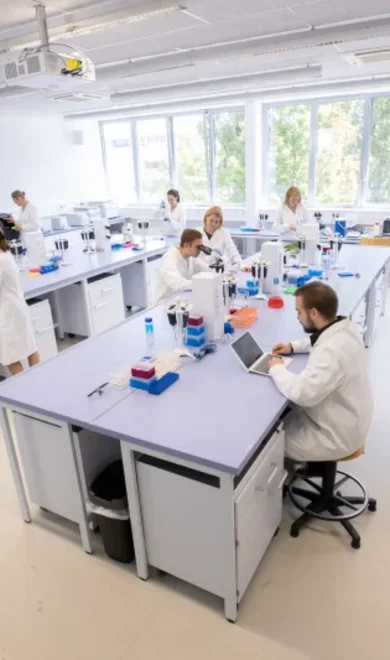
Spanning around 2,000 m², HWN Tulln provides facilities for study, teaching and research. Seven laboratories cover various fields of biotechnology and the life sciences – ranging from molecular biology studies and fermentation to fluorescence microscopy and Raman spectroscopy.
Investigate. Understand. Think ahead.
-
7
Laboratories
-
7
Lecture theatres
-
3
Seminar rooms
-
1
Computer room
-
+
Study and lounge areas, library
Our laboratories: This is where science comes to life.
From chemical analyses and the cultivation of microorganisms to the study of cells and proteins: discover the seven laboratories at HWN Tulln and their areas of application.
-
-
Molecular biology
-
Fermentation laboratory
-
Analytics 1
-
Analytics 2
-
Clinical Chemistry
-
Spectroscopy
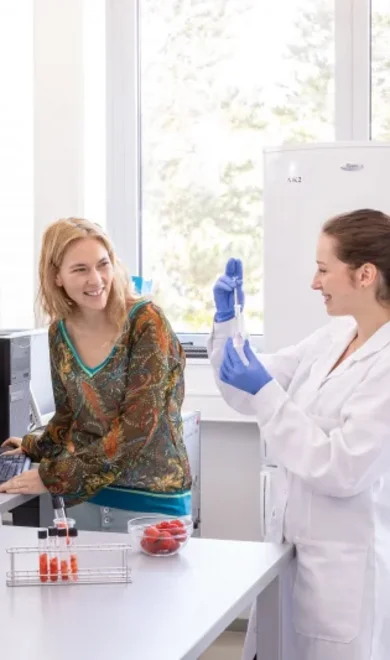
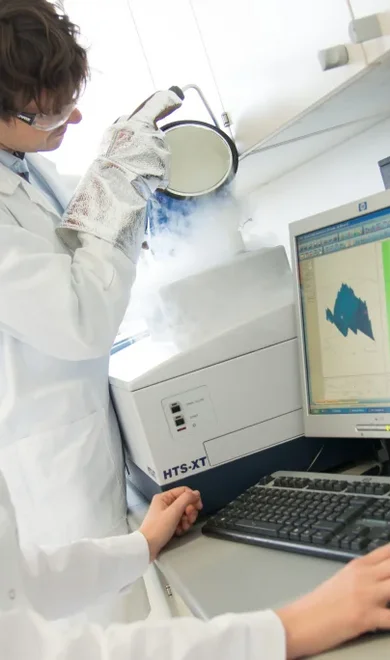
Facilities, Methods & Areas of Application of our laboratories
What types of tests can be carried out in the laboratories? Here you will find details of the areas of testing, the methods used and the key equipment in the seven laboratories.
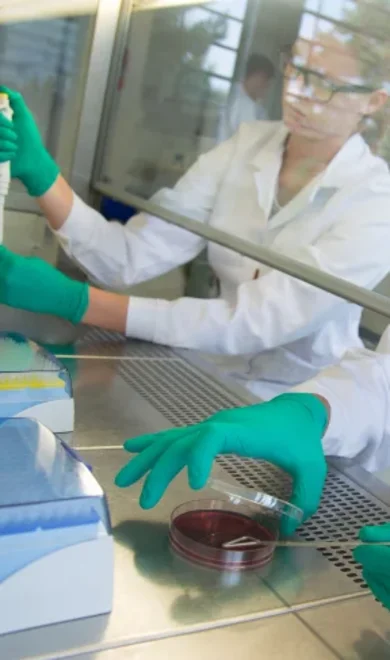
Microbiology
In this laboratory, basic microbiological techniques are carried out and samples are mechanically processed.
The equipment includes, amongst other things:
Certomat BS-1 – Sartorius
shaking incubator with heating and cooling unitIncubators – Ehret
Grinding system for Eppendorf
tubes – mechanical preparation of small sample quantities.Muffle furnace ELF 11/14B – Carbolite
Thermal treatment with programmable temperature profiles.Planetary
mill with a 150-ml grinding jar and silicon nitride grinding beads.Rotary evaporator
Complete system with control and drive unit, 6-litre heating bath, evaporating flask up to 20 litres and receiving flask with a capacity of 10 litres
Vibrating
mill Sample preparation by mechanical grinding.Drying cabinets – Ehret and Binder
Centrifugal
mill: Mill with an impact rotor or pin insert and a vibrating feed chute.
Molecular biology
This laboratory carries out research into cell and molecular biology. DNA, RNA and proteins are analysed using PCR, electrophoresis and microarray technology. Fluorescence microscopy and flow cytometry enable the analysis of cells.
The equipment includes, amongst other things:
CytoFLEX S – Beckman Coulter
flow cytometer for multiparametric analysis of individual cells and particles with six detection channels.Electrophoresis systems
for the separation and visualisation of nucleic acids.Electroporator
: for the introduction of foreign DNA into bacteria and fungi.Fluorescence
microscope: for visualising fluorescent labels in cell preparations and thin sections.Microarray printer & scanner
: High-throughput screening of genes, transcripts and proteins.Real-time PCR and PCR systems
: Quantitative and qualitative DNA detection.
Fermentation laboratory
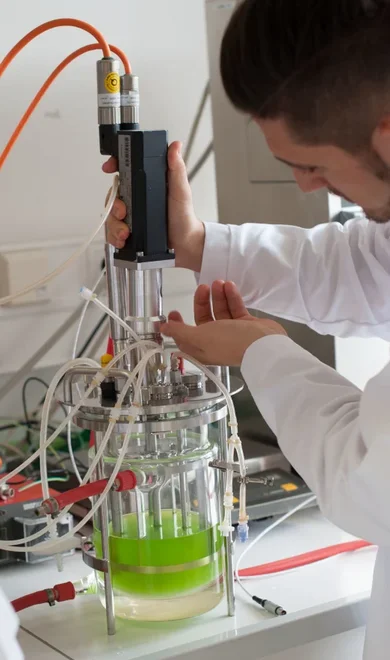
In this laboratory, microorganisms are cultured under aerobic and anaerobic conditions and fermentation processes are optimised in bioreactors.
The equipment includes, amongst other things:
Fermentation
system: a system for operating three bioreactors with a working volume of 0.5–2 litres.Benchtop
autoclave: An autoclave with rapid cooling and a capacity of 85 litres for the sterilisation and decontamination of media and materials.Class 2
safety cabinet: a work area for sterile work with microorganisms.
Analytics 1
This laboratory teaches both basic chemical and biomedical techniques. In the field of chemistry, the focus is on wet chemical analysis methods, sample preparation and ecotoxicological investigations. The biomedical field encompasses haematological investigations as well as the preparation and microscopic analysis of histological tissue sections.
The equipment includes, amongst other things:
ASE extraction system
: Accelerated solvent extraction under high pressure.CHNS-O elemental analyser
: determination of elemental composition based on Turboflash combustion technology.Alpha 2-4 LSC
freeze-dryer: freeze-drying down to −85 °C with temperature-controlled shelves.Karl Fischer coulometer
: Water determination from 1 ppm to 5 per cent in liquid and solid samples using the ‘Stromboli’ sample changer.MEV – Slee
cryostat: Preparation of frozen tissue sections for microscopic examination.LUMISTOX rapid test system
: luminescent bacterium test with temperature-controlled block for ecotoxicological analyses.Slide and rotary
microtomes: Preparation of tissue sections with a thickness of 1–10 µm.SOXTHERM extraction system
: Automated Soxhlet extraction with up to four sample positions.Sysmex XN-330
Fully automated haematology analyser with fluorescence flow cytometry, impedance measurement and the SLS method for haemoglobin determination.VAPODEST steam distiller
: Steam distillation of various chemical compounds, including for Kjeldahl nitrogen analysis.
Analytics 2
This laboratory utilises chromatographic, electrophoretic and bioanalytical methods for the purification, separation, identification and quantification of biological and chemical analytes. State-of-the-art analytical instruments and a range of detector systems are available for this purpose.
The equipment includes, amongst other things:
Concentrator 5301 – Eppendorf
Gentle concentration and drying of samples by vacuum centrifugation.GC-MS and GC-FID –
Separation and analysis of volatile compounds using gas chromatography with mass spectrometric or flame ionisation detection.HPLC-DAD, HPLC-FLD and HPLC-RID
– Analytical liquid chromatography with diode array, fluorescence and refractive index detection, as well as a fraction collector.Micro HPLC-DAD
: Separation and analysis of small sample volumes using micro-liquid chromatography with diode array detection.MPLC-UV/VIS
Preparative separation and purification of substances using medium-pressure liquid chromatography with UV/VIS detection.Rotavapor BÜCHI R-200/20
Evaporation and concentration of liquids.SDS-PAGE electrophoresis and Western blot systems
: separation, detection and visualisation of proteins.Nitrogen tent – Captair Field Pyramid erlab
Protection of sensitive samples against humidity and oxygen (80 × 60 cm).Tecan plate photometer
: Measurement of absorbance (UV/VIS), fluorescence and luminescence in microtitre plates (6 to 384 wells) using Magellan software.
Clinical Chemistry
This laboratory carries out clinical laboratory tests in the fields of immunohaematology, haemostasiology and clinical chemistry. The focus is on determining diagnostically relevant parameters in blood, serum, plasma and urine.
The equipment includes, amongst other things:
ÄKTA Explorer – System 1 and System 2
: Two temperature-controlled systems for preparative chromatography, enabling flow rates from 0.1 to 100 mL/min, sample loading in the µL to L range, and online monitoring via UV/VIS, conductivity and pH detection.Immunohaematology laboratory equipment – Bio-Rad
centrifuges, pipetting systems and gel card systems for immunohaematological diagnostics and blood group determination.STart Max – Stago
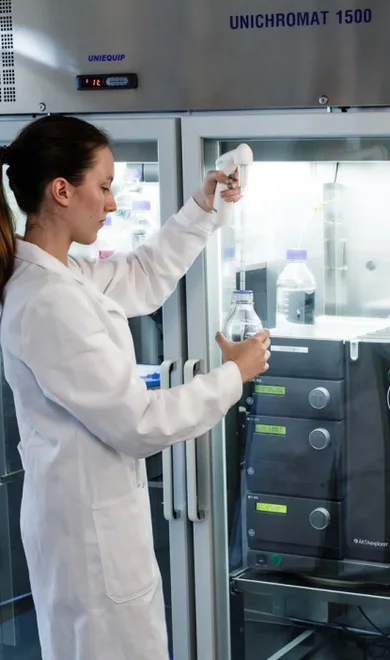
semi-automatic haemostasis analyser for the coagulometric and chromogenic determination of plasma coagulation parameters.UNICHROMAT Incubator
– Temperature control for FPLC systems.Urisys 1100 – Roche
urine strip analyser for the qualitative and semi-quantitative determination of clinical chemistry urine parameters using reflectometric measurement.
Spectroscopy
Infrared and Raman spectroscopy, as well as confocal Raman microscopy, enable the analysis of complex samples, chemical imaging and the generation of spatially resolved depth profiles.
The equipment includes, amongst other things:
TENSOR 37 FTIR spectrometer – Bruker Optics
Wavenumber range: 7,500–370 cm⁻¹
ATR technology and 96-well high-throughput screening
DTGS/MCT detectors
MPA FTNIR spectrometer – Bruker Optics
Transmission measurements with cuvette well
Diffuse reflection for inhomogeneous samples
Connection option for measurement probes
SENTERRA Raman microscope – Bruker
Chemical analysis with spatial resolution in the micrometre range
Two lasers at 785 and 532 nm
Motorised XYZ sample stage
Chemical imaging
Confocal imaging of depth profiles
Modular Raman spectrometer system – WasatchPhotonics
1064 nm laser (3B)
Fibre input aperture
Applying scientific methods yourself.
The laboratory infrastructure at HWN Tulln facilitates a wide range of research activities in biotechnology, molecular biology and bioanalytics. In addition to molecular biological analytical methods and fermentation techniques, high-resolution mass spectrometry for proteomics analyses is available through external partnerships. The scientific expertise required to evaluate and interpret complex data is firmly established within the university itself.
