


An insight into the Master’s in Consumer Research & Data-Driven Marketing
Master Consumer Research & Data-Driven Marketing
This degree programme is taught in German.
Data rather than assumptions: On the Master’s programme in Consumer Research & Data-Driven Marketing at HWN Wieselburg (formerly FHWN), you’ll become an analytics expert and a marketing strategist. You’ll learn qualitative, quantitative and technical methods – from eye-tracking to predictive analytics – and translate data into effective strategies. Part-time with Blended Learning+: one weekend on campus per month, with the rest delivered online and flexibly.

Start where your questions begin.
Key facts about the degree programme
Content-
Academic degree
Master of Arts in Business (MA)
-
Duration
4 semesters (120 ECTS)
-
Organisation
extra-occupational
-
Location
HWN Wieselburg
-
Language
German
-
Start
10.09.2027
-
Application date
05.10.2026 - 15.06.2027
-
Places available
25
Study schedule & fees.
Friday & Saturday, 09:15–18:00 | Blended Learning+: approximately one-third each of face-to-face sessions, online teaching and self-study | Face-to-face sessions every third weekend
The sample timetable from last year shows you how the courses in the degree programme might be organised in terms of timings. Actual course timings may differ from this.
Detailed curriculum for the Master’s programme
ContentHere’s what you can expect on the Master’s in Data-Driven Marketing
The degree programme combines consumer psychology, market research methodology and data-driven marketing to create a programme that is unique in Austria. Right from the start, you’ll be working on real-world cases: you’ll design studies, collect data using both traditional and technological methods, and translate the findings into marketing decisions.
-
Understanding consumers
Through consumer psychology, neuropsychology and behavioural economics, you will learn why people buy what they buy – and what conscious and unconscious processes lie behind it.
-
Mastering market research methodology
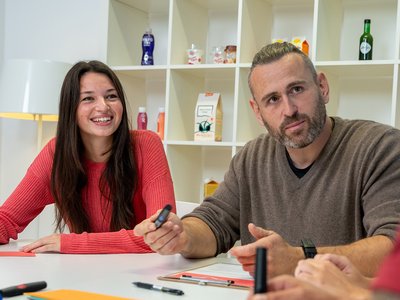
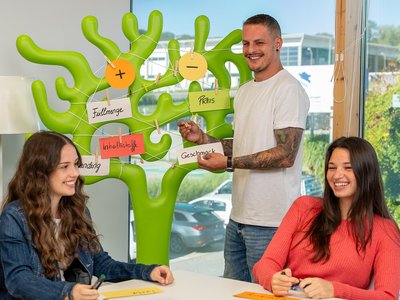
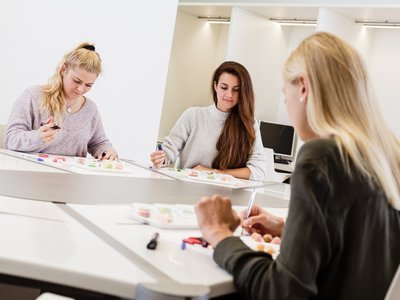
You plan, carry out and analyse – using both qualitative methods (focus groups, diary studies, usability tests) and quantitative methods (surveys, multivariate analysis).
-
Conducting research using instrumental methods
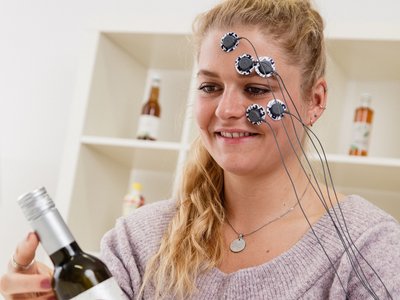
You’ll be working with eye-tracking and EEG, and you’ll learn which measurement method is best suited to which research question.
-
Using big data and AI
You are proficient in data mining and predictive analytics, and apply AI-based methods to real-world datasets.
-
Using sensors
You will plan and analyse sensory tests and use the results to formulate recommendations for product development and marketing.
-
Designing data-driven marketing
You combine insights from digital marketing, emotional branding, customer experience and customer relationship management to develop effective strategies.
-
Data storytelling and visualisation
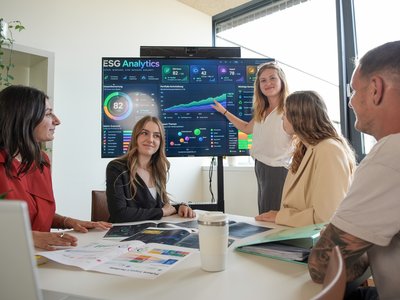
You analyse data in such a way that figures are transformed into compelling narratives that inform well-founded decisions.
-
Working in a scientific and practical manner
You’ll apply your knowledge to real-world projects with companies and market research organisations – from the initial briefing right through to the presentation.
The Curriculum & the Course Descriptions
1. Semester
Course
ECTS
- Consumer Psychology & Consumer Behaviour
- Current Issues and Trends
- Digital Marketing & Data Visualization
- Marketing & Management
- Market and Consumer Research
- Qualitative Market and Consumer Research Methods
- Quantitative Market and Consumer Research Methods
- Neuropsychology
- Research Skills
- Social Skills I: Communication and Moderation
2. Semester
Course
ECTS
- Behavioural Economics
- Fundamentals and Methods of Sensory Analysis
- Market Environment & Market Analysis
- Data Mining Methods
- Multivariate Methods
- Online Consumer Research
- Practical Insights I: Institute Cooperation
- Legal Aspects of Consumer Research
- Exercises – Qualitative Market and Consumer Research
3. Semester
Course
ECTS
- Behavioural Insights
- Customer Relationship Management
- Data Science
- Emotional Branding & Customer Experience
- Experimental Design
- Research Seminar
- Master’s Thesis Seminar
- Practical Insights II: Corporate Project
- Social Skills II: Leadership Skills and Conflict Management
- Usability Testing
- Target Groups & Lifestyles
4. Semester
Course
ECTS
- Defense of the Master’s Thesis
- Ethical Aspects of the Market Environment
- Communication and Media Psychology
- Consumer-Oriented Innovation Management
- Master’s Thesis
- Multisensory Marketing
Additional qualifications that will help you get ahead
As well as your Master’s degree, you can earn certificates during your studies that will make you stand out straight away in the job market. Thanks to the curriculum’s focus on sensory analysis methodology, you can, amongst other things, obtain DLG certification. This means you’ll be building up qualifications that count in market research and marketing whilst you’re still studying.
Data Protection Officer
By taking an Optional Course, you can qualify as a data protection officer and learn how the GDPR is implemented in day-to-day working life. This is a clear advantage, particularly in market and consumer research, where you are constantly working with survey and behavioural data.
DLG Junior Advanced Sensory Evaluation Manager
Thanks to the curriculum’s focus on sensory analysis, you can obtain certification from the German Agricultural Society (DLG) as a Junior Advanced Sensory Analysis Manager. This certification demonstrates that you are able to plan, carry out and evaluate sensory tests independently – a skill in high demand in product development, quality assurance and consumer research. This is an optional additional programme, available every two years.
pma/IPMA® project management certification (optional)
As a student at Wiener Neustadt University of Applied Sciences, you can obtain an internationally recognised pma/IPMA® project management certification in addition to your degree – recognised proof of project management competence and a clear advantage in any job application. The certification is an optional extra offered as an elective module. The HWN offers a dedicated preparation course to help you prepare specifically for the exam. You’ll sit the certification exam at pma (Projekt Management Austria). As HWN is a corporate member of pma, you’ll benefit from a reduced fee.
TOEFL ITP
The TOEFL ITP provides standardised proof of your level of English – a real asset when applying for a place on a semester abroad programme and for your CV. This is optional.
Industry partners from the fields of market research and marketing
You’ll work on real-world projects with leading market research organisations and companies – from the initial briefing right through to presenting the results to the client. This will enable you to deepen your methodological knowledge and build a professional network early on. In the summer semester of 2026, for example, students collaborated with INTEGRAL Market and Opinion Research and Marketagent on real-world studies based on representative samples – such as those relating to the 2026 FIFA World Cup or sustainable tourism.
Another highlight is the study trip to Amsterdam: there, working in cross-disciplinary teams, you’ll work on a real-world project and present your solution in a pitch presentation.


Projects & Study Insights
-
-
From the evaluation
to the recommendation -
Empathic Design
on ORF -
A semester,
a real-world assignmentThe research questions are drawn from real-world scenarios and range from defining target audiences to touchpoint analysis and customer loyalty. You decide for yourselves which method is most suitable, carry out the survey and analyse the results. Clients range from large corporations to local businesses and start-ups – the projects that come to fruition vary from cohort to cohort.
-
Study with me:
Consumer Research &
Data-Driven Marketing


Application and Admissions to the Master’s Programme
ContentHere’s how to apply as an applicant!
Would you like to apply for the master’s programme in Consumer Research & Data-Driven Marketing at HWN Wieselburg? Here you can find out what entry requirements you need to meet, how the admissions process works and what documents you’ll need. You can apply online via our application portal. If you have any questions about the programme or your application, either before or during the application process, Christa Scharner will be happy to help.
You can find the current application deadlines at the top of the ‘Key Facts’ section under ‘Programme structure, application deadlines & costs’.
Applications & Admissions
To be admitted to admissions, you must meet the following entry requirements:
A relevant Bachelor’s or Diplom degree (at least 180 ECTS) or an equivalent post-secondary qualification – e.g. from a study programme in economics or social sciences
- At least 2 ECTS in statistics or quantitative methods
- At least 10 ECTS in economics-related subjects
Are you still in the middle of your Bachelor’s degree? If so, you can apply now using your current transcript of records and submit your final degree certificate by the end of October.
Are you unsure whether your previous studies meet the entry requirements? Simply get in touch with us – we’ll assess your individual situation and work with you to find a solution. Depending on the scope of the missing content, it may be possible, for example, to catch up on this (or part of it) as part of a summer school programme.
Application Process & Admissions Procedure
You can apply online via the application portal. You can register using your email address or log in using ID Austria. The application portal will guide you through the application process and you can check the status of your application at any time.
Submit your application
Log in to the application portal, complete your application and upload the required documents. With ID Austria, any data already available can be imported, so you only need to add any missing details and documents.
Good to know: You don’t have to complete your application in one go: your entries are saved, and you can pause at any time, continue later and amend your details before finally submitting your application.
Checking your documents
We will check whether you meet the entry requirements and whether your documents are complete. If any documents are missing, you can submit them via the application portal.
Invitation to the admissions day
If you meet the requirements, we will invite you to a face-to-face admissions interview. During this interview, we would like to get to know you and find out about your motivation for studying. Of course, you will also have the opportunity to ask any questions you may have.
Admissions decision
Once the admissions process is complete, you will receive our decision promptly by email and via the application portal.
Acceptance & Start of Studies
Welcome to HWN Wieselburg! Once you have accepted your place, you will sign your educational agreement online via the application portal and pay the tuition fees and the ÖH contribution for the first semester.
Documents required for the application
You will usually need the following documents for your application:
Proof of your entry requirements (e.g. a Bachelor’s or diploma certificate)
CV
Photograph
Official photo ID
Tip: You can also log in to the application portal using ID Austria. This allows any existing data to be imported, which simplifies your application.
You can see exactly which documents you need to upload directly in the application portal. You can submit any missing documents later if necessary.
Did you complete your degree abroad?
If you obtained your school or university qualification abroad, there may be additional requirements for your application to HWN.
You should therefore find out well in advance about the language and subject-specific entry requirements for your chosen study programme, as well as the current entry and residence regulations in Austria. Please also note that translations and certified copies of your documents may be required.
Important: Your foreign academic qualifications will only be assessed on a case-by-case basis once you have submitted your application and – where required – paid the deposit in accordance with Section 4(5a) of the Foreigners Act (FHG). It is not possible to carry out a preliminary assessment of your documents. Further information on the costs involved can be found in our Tuition Fees and Charges Regulations in the Download Centre.
Please note: For applicants from third countries who require a visa or a residence permit, the earlier application deadline at the end of March applies. If this does not apply to you, we nevertheless recommend that you submit your application by the end of March at the latest to allow sufficient time for your documents to be assessed. However, the application deadlines for your chosen study programme also apply.
Options for crediting
Have you already completed parts of your degree at another higher education institution? If so, you can submit an application for credit transfer within the first four weeks of your programme. We always assess on a case-by-case basis whether previously completed modules can be recognised – depending on the content and scope of the course, as well as your prior learning from your Bachelor’s or Diplom degree.
What happens during the admissions interview?
The admissions process consists of a face-to-face interview lasting around 30 minutes. The focus is on your motivation, your background to date and your qualifications – we want to find out whether the study programme is right for you. You do not need to prepare for the interview in terms of content.
Place of study
ContentYour Master’s in Consumer Research at HWN Wieselburg
At HWN Wieselburg, you’ll study in a green setting – with everything close at hand, a friendly atmosphere and modern research facilities ranging from eye-tracking to EEG. The site combines marketing, green technology and creative thinking, and has close links with businesses and market research organisations.
For your on-campus weekends, the Campus Hostel is available to you with free accommodation from Thursday to Saturday (subject to availability).

Your career after graduation
ContentWorking as a consumer research and marketing expert
Data analysts and marketing professionals are in greater demand than ever. With the Master’s in Consumer Research & Data-Driven Marketing, you’ll be right at home in an environment where companies rely on data rather than gut instinct. Around half of our graduates go on to work directly in renowned market research organisations – as all-round consultants, not merely as survey coordinators. The other half work in marketing departments, in product or brand management, or in management consultancy – mostly in teams that make data-driven decisions. The programme is recommended by the Austrian Market Research Association (VMÖ), and graduates are actively sought after by research organisations.
In your day-to-day work, you can expect tasks such as these:
What jobs await you after graduation
Thanks to the interdisciplinary and practice-oriented degree programme, a wide range of career opportunities is open to you – including the following roles:
- Market Researcher
- Consumer Insights Specialist
- Data Analyst / Marketing Analyst
- Brand Manager
- Product Manager
- Customer Experience Manager
- Research Consultant
- Customer Relationship Manager
- Media Analyst
What students say about the study programme
-
By wearing an age simulation suit, I was able to simulate the everyday lives of older people and gain a better understanding of this target group.
-
What we really need are ‘Making Sense of Data’ departments – a foundation of knowledge about methods, combined with the ability to understand people and change.
-
The more comprehensive the knowledge of the target group, the better the offering and communication can be tailored to their requirements and needs.
-
The study programme has shown me how to combine information from different disciplines in order to understand the bigger picture. I have already been able to apply my knowledge in various professional situations.
-
Project partnerships with companies enable students to learn methods through practical experience, whilst making use of the HWN’s extensive facilities.
-
Collecting data, but also interpreting it correctly in order to make well-informed marketing decisions – that’s something that has always fascinated me.


Research & Infrastructure in the Master’s programme
ContentConducting research with facilities that are unique in Austria
Modern consumer research relies on measurement: how do people react to a product, a brand or packaging – both consciously and unconsciously? At HWN Wieselburg, you’ll conduct research using equipment that is unique in Austria in this particular combination. You’ll record emotional and neural responses using technical methods and conduct tests under standardised conditions.
-
Consumer Science Centre
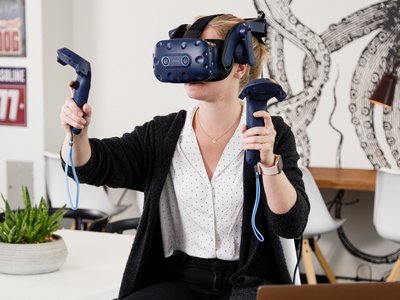
Test environments for consumer research: Facial coding to record emotional reactions, virtual and augmented reality settings for immersive test scenarios, and empathy design simulations (e.g. using glasses simulating ageing or visual impairment) for user-centred product design. In the focus group room featuring a one-way mirror, you can observe focus groups undisturbed.
-
Neuromarketing Lab
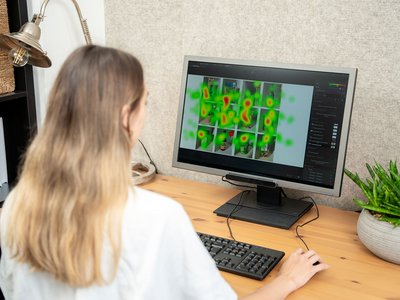
Instrumental methods for measuring physical and neural responses: EEG (electroencephalography), EMG (electromyography), EDA (electrodermal activity), implicit response time (IRT) tests, and mobile and stationary eye-tracking for measuring eye movements.
-
E-commerce Lab
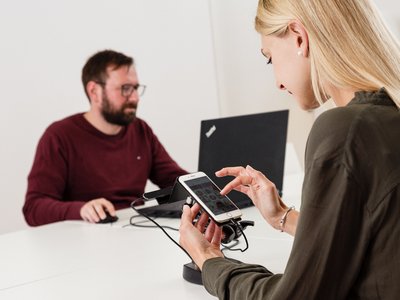
Here, you can investigate how people shop online: an eye-tracking station for desktops and smartphones, a mobile EEG, VR headsets and an interactive whiteboard. This allows you to test online shops, websites and digital customer journeys under realistic conditions – ideal for usability testing and online consumer research.
-
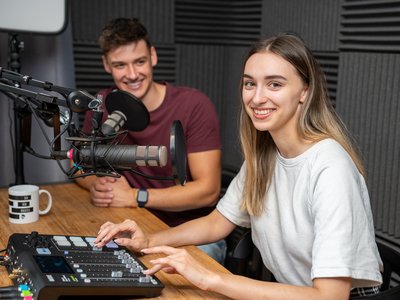
MediaLab with a podcast studio
Acoustically insulated studio for audio production, video and online streaming: microphones, system cameras, LED panels, Stream Deck and flexible furniture. Here, you can produce podcasts, videos and presentation formats – and practise communicating complex research findings in a compelling way.
-
Sensory laboratory
A sensory evaluation laboratory equipped in accordance with DIN EN ISO 8589, featuring 18 computer-assisted testing booths, a preparation kitchen, one-way mirrors for observation and LED lighting with a full RGB colour spectrum. Here, you will plan and evaluate analytical and hedonic tests.
In addition, further laboratories and workshops at HWN Wieselburg are available to you for your project work and final-year projects.
-
© HWN -
© HWN -
© HWN -
© HWN -
© HWN -

© HWN -
© HWN -
© HWN -
© HWN -
© HWN


Contact & personal advice
Content
To make sure no questions remain unanswered, please get in touch!
-
head of programme
-
Contact details for prospective students


Frequently Asked Questions and Answers
How does the Blended Learning+ format work on the Master’s in Consumer Research & Data-Driven Marketing?
The course follows a fixed three-week cycle comprising three phases. During the face-to-face weekends (Friday and Saturday), you will study at HWN Wieselburg, engaging directly with lecturers and fellow students. During the online phase, courses take place live in the virtual lecture theatre on Fridays and Saturdays – from any location, but with a fixed schedule. During the self-study phase, you work flexibly with digital learning materials whenever and wherever suits you. You’ll know well in advance when the on-campus sessions are taking place, allowing you to plan your work, family life and studies in the long term.
How often will I be at HWN Wieselburg?
On average, one weekend per month – usually Friday and Saturday. All other courses take place online in the virtual lecture theatre or as flexible self-study sessions. This means the course is perfectly manageable even if you don’t live in the region.
Can I work whilst studying for my Master’s degree?
Yes. The programme is designed to be compatible with full-time work. Working is not compulsory, but is recommended to ensure a practical focus – a maximum of 30 hours per week is recommended. Thanks to the predictable three-week cycle, the programme can be easily integrated into your daily working life.
Are there any places to stay at the HWN Wieselburg?
Yes. The Campus Hostel is located right next to HWN Wieselburg – with free accommodation available from Thursday to Saturday. Places are allocated subject to availability; you will receive details on how to use the hostel once you have been admitted to the course. You can find out more on our Accommodation page.
Do I need any prior knowledge of statistics?
You will need at least 2 ECTS in statistics or quantitative methods from your previous studies. During the course itself, the statistical fundamentals will be revisited at the start and explored in greater depth step by step. So you don’t need to be an expert in statistics, but you should enjoy working with numbers.
Is that a Master’s degree in market research?
Yes – and more than that. The Master’s in Consumer Research & Data-Driven Marketing provides you with methodological training in market and consumer research and is recommended by the Austrian Market Research Association (VMÖ). At the same time, you’ll learn how to translate findings into marketing strategies – so you’ll be not just a researcher, but also a strategist.
Is there a compulsory work placement?
No. As the programme is designed to be studied part-time, there is no compulsory work placement. Instead, the practical aspect is ensured through real-world projects with companies and market research organisations.
Can I spend a semester abroad whilst studying for my Master’s degree?
Yes, in the 4th semester. The range of partner universities extends from Europe (e.g. Germany, the Netherlands, France) to Asia (China, South Korea, Japan) and the Americas (the USA, Mexico, Canada).