Intelligent Systems & Mobility
You will be working on smart sensors, artificial intelligence, automated systems and electromobility, and developing technologies for connected vehicles and modern driver assistance systems.

From autonomous vehicles and smart sensors to state-of-the-art medical technology: on this mechatronics degree programme at HWN (formerly FHWN), you’ll learn how intelligent technical systems are developed. You’ll combine mechanical engineering, electronics and Informatics, and put your knowledge into practice right from the first semester in the laboratories at TechSpace Area27. From the fourth semester onwards, you’ll specialise in future-oriented fields such as mobility, aerospace or microsystems.
Academic degree
Bachelor of Science in Engineering (BSc)
Duration
6 semesters (180 ECTS)
Organisation
full-time
Location
Campus 1 | Wiener Neustadt
Language
German
Start
20.09.2027
Application date
05.10.2026 - 15.06.2027
Entry into the 2nd semester:
- 30.11.2026
Places available
30
Monday–Thursday, 9.00 am–6.00 pm | less than 10 per cent online
You won’t just learn how modern technology works – you’ll develop it yourself. As early as the first semester, you’ll build your first mechatronic system and work on projects that combine mechanics, electronics and software.
In the ‘Mechatronics Projects 1–3’ series, you’ll develop working solutions step by step – from the mechanical components through to the electronics and software. You’ll learn how to turn technical ideas into real prototypes.
You’ll learn programming languages such as C and Python, and later on you’ll explore machine learning and neural networks.
You’ll learn how modern sensors work and develop your own microsystems, such as those found in smartphones, vehicles or medical devices.
You will learn how to control processes, develop control loops and design stable and efficient systems.
You will programme microcontrollers, process sensor data and control motors, actuators and technical systems.
With MATLAB/Simulink, you can develop digital models to test systems virtually and optimise them at an early stage.
You will learn technical drawing and develop products and assemblies using professional CAD systems.
Mathematics, engineering mechanics and electrical engineering form the basis for understanding, calculating and optimising technical systems.
You can find the courses for the specialisations from the 4th semester onwards on the relevant subpages. They are not listed here, which is why the ECTS credits shown differ from the total number per semester.
You will be working on smart sensors, artificial intelligence, automated systems and electromobility, and developing technologies for connected vehicles and modern driver assistance systems.
You will oversee technical products from the initial concept right through to market launch, combining technical expertise with project and innovation management.
You’ll be working in the fields of aerodynamics, aircraft development and modern manufacturing technologies – in one of the most exciting high-tech sectors.
You will develop and analyse microsystems and nanotechnologies such as those used in smartphones, medical technology, sensors and the semiconductor industry.

Study with me:
Mechatronics & Microsystems Engineering
What is it like to study Mechatronics & Microsystems Engineering?
As well as your bachelor’s degree, you can obtain recognised certificates in engineering and project management. This allows you to build up additional qualifications whilst you’re still studying, which will be clearly recognised in the workplace.
CLAD (Certified LabVIEW Associate Developer) Official certificate in LabVIEW programming. You demonstrate that you are able to develop measurement, test and automation systems.
Six Sigma Green Belt A recognised method for process and quality improvement. You will learn how to reduce errors and optimise development processes in a measurable way.

pma/IPMA® Project Management Certification As a student at Wiener Neustadt University of Applied Sciences, you can obtain an internationally recognised pma/IPMA® project management certification in addition to your degree – recognised proof of project management competence and a clear advantage in any job application. The certification is an optional extra offered as an elective module. The HWN offers a dedicated preparation course to help you prepare specifically for the exam. You’ll sit the certification exam at pma (Projekt Management Austria). As HWN is a corporate member of pma, you’ll benefit from a reduced fee.
Hydrogen-powered vehicles that are becoming more efficient. Production facilities that monitor themselves. Medical devices that measure with greater precision. These are the kinds of topics being researched on the study programme – and you’ll be right at the heart of it. Through projects, work placements and your bachelor's thesis, you’ll collaborate with companies such as Bosch, MAGNA, ams OSRAM, ZKW, BRP-Rotax, Beyond Gravity and Cubicure. Through partnerships with CERN, MedAustron, AIT and the Wiener Neustadt Technology and Research Centre, you’ll gain insights into cutting-edge research. This allows you to gain real-world experience and build a professional network to kick-start your career whilst you’re still studying.





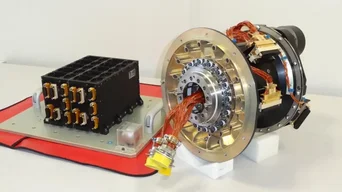
Mechatronics on its way to Mercury: HWN has developed test electronics and test software for the ESA’s BepiColombo mission.
BepiColombo is a joint mission between the European Space Agency (ESA) and the Japan Aerospace Exploration Agency (JAXA). It was launched in 2018 to explore Mercury. As part of the ‘Thruster Pointing Assembly’ (TPA) project, test electronics and test software were developed at HWN – an example of how mechatronics expertise from Wiener Neustadt extends into the field of international space exploration.
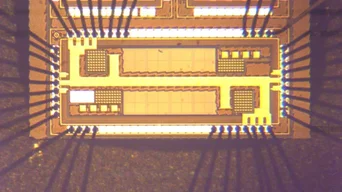
Quantum technology on a chip: The ICAS project is integrating cold-atom-based sensors into the CMOS platform.
Sensors based on cold atom technology are regarded as the key to high-precision measurements of the future. The ICAS project is investigating how such sensors can be integrated with the CMOS platform – in other words, with the technology on which modern microchips are also based. In doing so, ICAS combines microsystems engineering with quantum technology.
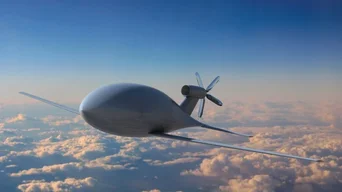
Designing the aircraft of tomorrow: The Aerospace Engineering Department at HWN is working on concepts for the transport of people and goods.
As part of the Aircraft Design Studies programme, the Department of Aerospace Engineering at HWN is involved in aircraft design projects for passenger and freight transport. Students specialising in Aerospace Engineering learn precisely these methods in the ‘Introduction to Aircraft Design’ module – from the design of the aircraft configuration through to calculations using design software.
Mechatronics meets biotechnology: an automated control system optimises the growth conditions for microorganisms.
For microorganisms to grow optimally in bioreactors, the conditions must be precisely right. In the AFCoSy project, bioreactors were replicated in the laboratory using shaking flasks, and an automated fermentation control system was developed – an example of how sensor technology, control engineering and software are also used in the life sciences.
Precise measurement using simple methods: analysing deformations and vibrations – using standard webcams instead of expensive measurement systems.
Expensive, specialised measurement systems are usually employed for deformation analyses. The aim of the project is to measure spatial vibrations using standard webcams or simple industrial cameras. Stereo correlation is used to analyse the images from multiple cameras in order to capture movements and deformations in three dimensions.
Greater range for electric cars: the project optimises the reliability and efficiency of electric powertrain systems.
Range is one of the biggest challenges facing electric mobility. The ‘Electric Drive of the Future’ project is working to make electric drive systems more reliable and efficient, thereby enabling electric vehicles to achieve greater ranges. These topics also play a central role in the Intelligent Systems & Mobility specialisation.
Would you like to apply for the Bachelor’s degree in Mechatronics & Microsystems Engineering at HWN? Here you can find out what entry requirements you need to meet, how the admissions process works and what documents you’ll need. You can apply online via our application portal. If you have any questions about the degree programme or your application, either before or during the application process, Klaudia Kopp will be happy to help.
You can find the current application deadlines at the top of the ‘Key Facts’ section under ‘Organisation of studies, application deadlines & costs’.
To be admitted to the bachelor’s programme in Mechatronics & Microsystems Engineering, you must meet one of the following entry requirements:
If you do not have the school-leaving certificate(s), find out more about ‘Studying without school-leaving certificate(s)’
If you have completed an HTL course in a relevant subject area, you may be able to join the programme directly in the second semester. Whether you meet the entry requirements depends on the subject area of your HTL course.
The following HTL specialisations allow direct entry:
We will assess on a case-by-case basis whether your previous academic achievements can be recognised; please feel free to contact us for further details.
You can apply online via the application portal. You can register using your email address or log in using ID Austria. The application portal will guide you through the application process and you can check the status of your application at any time.
Submit your application
Log in to the application portal, complete your application and upload the required documents. With ID Austria, any data already available can be imported, so you only need to add any missing details and documents.
Good to know: You can apply even before you’ve finished school and submit any missing documents later. You don’t have to complete your application in one go: your entries are saved, so you can pause at any time, continue later and amend your details before finally submitting.
Checking your documents
We’ll check whether you meet the entry requirements and whether your documents are complete. If any documents are missing, you can submit them via the application portal.
Personal admissions interview
If you meet the requirements, we will invite you to a personal admissions interview. During this interview, we would like to get to know you and understand your motivation for studying. Of course, you will also have the opportunity to ask any questions you may have.
Admissions decision
Once the admissions process is complete, you will receive the decision by email and via the application portal.
Acceptance & Start of Studies
Once you have accepted your place, you will sign your educational agreement online via the application portal and pay the tuition fees and the ÖH contribution for the first semester.
You will usually need the following documents for your application:
Proof of your entry requirements (e.g. Matura or vocational qualification certificate). You can apply before you have taken your Matura, using your most recent school report, and submit your Matura certificate at a later date.
CV
Photograph
Official photo ID
For direct entry into the second semester: certificate from your relevant HTL
Tip: You can also log in to the application portal using ID Austria. This allows any data already available to be imported, which simplifies your application.
You can see exactly which documents you need to upload directly in the application portal. You can submit any missing documents later if necessary.
Have you already completed a vocational training programme or undertaken university-level studies? Whether these can be recognised towards your degree will be assessed on a case-by-case basis. There is no automatic recognition.
If you obtained your school or university qualification abroad, there may be additional requirements for your application to HWN.
You should therefore find out well in advance about the language and subject-specific entry requirements for your chosen study programme, as well as the current entry and residence regulations in Austria. Please also note that translations and certified copies of your documents may be required.
Important: Your foreign academic qualifications will only be assessed on a case-by-case basis once you have submitted your application and – where required – paid the deposit in accordance with Section 4(5a) of the Foreigners Act (FHG). It is not possible to carry out a preliminary assessment of your documents. Further information on the costs involved can be found in our Tuition Fees and Charges Regulations. (Link – Download Centre)
Please note: For applicants from third countries who require a visa or a residence permit, the earlier application deadline at the end of March applies. If this does not apply to you, we nevertheless recommend that you submit your application by the end of March at the latest to allow sufficient time for your documents to be assessed. However, the application deadlines for your chosen study programme also apply.
At Campus 1 of HWN, you’ll study in a forward-looking environment with a focus on future technology. Right on site, at TechSpace Area27, you’ll have access to ten state-of-the-art laboratories and a mechanical workshop. Thanks to companies and research institutions in the region, you’ll be closely connected to the world of work.

After completing your degree, you will develop technologies that will shape our future – such as autonomous vehicles, smart production facilities, medical microsystems, aerospace technologies or innovative semiconductor solutions.
Depending on your specialisation and interests, a range of career paths in engineering and industry will open up to you:
Theory is important – but the best way to learn about technology is by developing it yourself. That’s why, as part of your degree, you’ll be working in ten specialised laboratories at TechSpace Area27. Here, you’ll build prototypes, develop sensors, test technical systems and work with technologies that are otherwise mainly used in research institutions and high-tech companies.
Develop microsystems, sensors and microelectronic components – from digital planning through to manufacturing and analysis.
Combine mechanics, electronics and software to develop fully functional intelligent systems.
Design and analyse electronic circuits and learn about the components used in modern technology.
Collect measurement data from technical systems, analyse it and use it to understand and optimise technical processes.
Work with electric drives, energy technology and modern sensor systems – for example, in industry and e-mobility.
Investigate motion and vibrations, record their behaviour through measurements, and learn how to influence them in a targeted manner.
I work with optical systems and lighting technologies for sensor technology, communications and medical technology.
Discover the technologies behind radio, radar and communications systems – and, in doing so, the foundations of our connected world.
Make your own finished printed circuit boards for your projects – from the electronic circuit right through to the finished prototype.
Manufacture and machine components for your projects and turn your designs into real products in the Innovation Lab.
In their master’s theses, students tackle real-world problems from research and industry – ranging from simulation and control engineering to additive manufacturing. You can get an idea of this in the Mechatronics Proceedings, the annual anthologies of the best theses.
Every year, lecturers submit outstanding student work to the Mechatronics Platform conference. In 2024, the conference took place at Wiener Neustadt University of Applied Sciences. With a bit of luck, you could win an award and have your work published in the annual conference proceedings.
Prof. (FH) Dipl.-Ing. Wolfgang Haindl
head of programme
Contact details for prospective students
No. The specialisations only begin from the fourth semester onwards. You have four options: Engineering Management, Aerospace, Intelligent Systems & Mobility, and Micro- & Nanoengineering. This allows you to explore specific sub-fields of mechatronics through industry-relevant projects and set your own area of specialisation.
Yes. In the third semester, you can spend a semester abroad at one of HWN Wiener Neustadt University of Applied Sciences’ partner universities. The study services team will be happy to advise you.
In the sixth semester, you will undertake a work placement at a company recognised by HWN. Examples include Otto Bock Healthcare, AVL List GmbH, ZKW Group and Diamond Aircraft. The work placement lasts for at least 12 weeks, with 30 hours per week, and may also take place abroad. You can find a template for the educational agreement in the Download Centre.
The course is structured in such a way that you do not need any prior technical knowledge. Admission is possible with an Austrian school-leaving certificate, an equivalent foreign qualification or a relevant university entrance qualification. If you have completed a relevant HTL course, you may, under certain conditions, join the programme directly in the second semester. You can find out more under ‘entry requirements & admission’.


