Industrial robotics
How do technical systems learn to act independently? You’ll be working with smart sensors, AI and automated systems – and developing technologies for connected vehicles and smart applications.

This degree programme is taught in German.
How do you teach robots to see, learn and make decisions independently? On the Robotics & AI degree programme at HWN (formerly FHWN), you will develop and programme autonomous systems that perceive their environment, learn from data and act intelligently. From the very first semester, you’ll be working with robotic systems in the lab, combining sensor technology, software and AI. From the third semester onwards, you’ll specialise in industrial or mobile robotics.

Academic degree
Bachelor of Science in Engineering (BSc)
Duration
6 semesters (180 ECTS)
Organisation
full-time
Location
Campus 1 | Wiener Neustadt
Language
German
Start
20.09.2027
Application date
05.10.2026 - 15.06.2027
Entry into the 2nd semester:
- 30.11.2026
Places available
30
Monday–Thursday between 08:00 and 18:00 | mainly face-to-face
The sample timetable from last year shows you how courses might be organised in terms of timings. Actual course times may differ from this.
You’ll learn to programme robots, control their movements and understand their environment – not just on a screen, but right there in the lab. You’ll lay the technical foundations for this through mathematics, Informatics, mechanics and electrical engineering.
Using Python, you’ll develop structured code that enables robots to carry out tasks, react to their environment and manage complex processes independently.
You programme microcontrollers directly on the robot so that sensors, cameras and actuators (e.g. motors or grippers) can work together in real time.
You will design the kinematics – that is, the robot’s motion sequences – integrate sensors and actuators, and connect all components via ROS (Robot Operating System), a well-established software framework in robotics.
Using control engineering methods, you ensure that the robots carry out their movements in a stable, precise and reliable manner.
With the help of computer vision and image recognition, your robot learns to identify objects, estimate distances and understand its surroundings.
You will develop and train AI models that can learn from data and make decisions independently – for example, for autonomous navigation or intelligent object recognition.
You will initially develop and test robotic systems in a virtual environment, analyse their behaviour and optimise their movement sequences before they are deployed on real hardware.
In addition to your bachelor’s degree, you can gain recognised certificates by completing the following certification programmes:
MATLAB Academy You will use MATLAB from MathWorks throughout your degree to solve technical problems, analyse data and evaluate results. Through the MATLAB Academy, you will deepen your knowledge in practical courses and demonstrate your skills with personalised certificates.
pma/IPMA® Project Management Certification The internationally recognised pma/IPMA® project management certification serves as recognised proof of project management competence and is a clear asset for any applicant.
Data Protection Officer – Austrian Standards The Data Protection Officer certification is offered as part of the ‘Data Protection Officer’ Optional Course and is suitable for anyone wishing to deepen their knowledge of data protection and qualify as a Data Protection Officer. Upon successful completion of the Optional Course, students have the opportunity to obtain certification from Austrian Standards and/or TÜV.
Data Protection Officer – TÜV




Study with me:
Robotics & AI
“In robotics, there’s always a new challenge. My next challenge: to develop and implement specific robotic solutions for an innovative company.”
“Whilst studying robotics, I took advantage of the opportunities for study abroad in the 3rd and 6th semesters to gain educational and intercultural experiences.”
"Programming is a key focus of my degree course. My understanding of it has developed from simple tasks to complex algorithms."
"Throughout our degree programme, we work on individual robotics projects right from the start, thereby putting theory into practice straight away."
Would you like to apply to study Robotics & Artificial Intelligence at HWN? Here you can find out what entry requirements you need to meet, how the admissions process works and what documents you’ll need. You apply online via our application portal. If you have any questions about the degree programme or your application, either before or during the application process, Klaudia Kopp will be happy to help.
You can find the current application deadlines at the top of the ‘Key Facts’ section under ‘Organisation of studies, application deadlines & costs’.
To be admitted to the bachelor’s programme in Robotics & Artificial Intelligence, you must meet one of the following entry requirements:
If you do not have the school-leaving certificate(s), find out more about ‘Studying without school-leaving certificate(s)’
If you have completed an HTL course in a relevant subject area, you may be able to join the programme directly in the second semester. Whether you meet the entry requirements depends on the subject area of your HTL course.
The following HTL specialisations allow direct entry:
We will assess on a case-by-case basis whether your previous academic achievements can be recognised; please feel free to contact us for further details.
You can apply online via the application portal. You can register using your email address or log in using ID Austria. The application portal will guide you through the application process and you can check the status of your application at any time.
Submit your application
Log in to the application portal, complete your application and upload the required documents. With ID Austria, any data already available can be imported, so you only need to add any missing details and documents.
Good to know: You can apply even before you’ve finished school and submit any missing documents later. You don’t have to complete your application in one go: your entries are saved, and you can pause at any time, continue later and amend your details before finally submitting.
Checking your documents
We’ll check whether you meet the entry requirements and whether your documents are complete. If any documents are missing, you can submit them via the application portal.
Personal admissions interview
If you meet the requirements, we will invite you to a personal admissions interview. During this interview, we would like to get to know you and understand your motivation for studying. Of course, you will also have the opportunity to ask any questions you may have.
Admissions decision
Once the admissions process is complete, you will receive the decision by email and via the application portal.
Acceptance & Start of Studies
Once you have accepted your place, you will sign your educational agreement online via the application portal and pay the tuition fees and the ÖH contribution for the first semester.
You will usually need the following documents for your application:
Proof of your entry requirements (e.g. Matura or vocational qualification certificate). You can apply before you have taken your Matura, using your most recent school report, and submit your Matura certificate at a later date.
CV
Photograph
Official photo ID
For direct entry into the second semester: certificate from your relevant HTL
Tip: You can also log in to the application portal using ID Austria. This allows any data already available to be imported, which simplifies your application.
You can see exactly which documents you need to upload directly in the application portal. You can submit any missing documents later if necessary.
Have you already completed a vocational training programme or undertaken university-level studies? Whether these can be recognised towards your degree will be assessed on a case-by-case basis. There is no automatic recognition.
If you obtained your school or university qualification abroad, there may be additional requirements for your application to HWN.
You should therefore find out well in advance about the language and subject-specific entry requirements for your chosen study programme, as well as the current entry and residence regulations in Austria. Please also note that translations and certified copies of your documents may be required.
Important: Your foreign academic qualifications will only be assessed on a case-by-case basis once you have submitted your application and – where required – paid the deposit in accordance with Section 4(5a) of the Foreigners Act (FHG). It is not possible to carry out a preliminary assessment of your documents. Further information on the costs involved can be found in our Tuition Fees and Charges Regulations. (Link – Download Centre)
Please note: For applicants from third countries who require a visa or a residence permit, the earlier application deadline at the end of March applies. If this does not apply to you, we nevertheless recommend that you submit your application by the end of March at the latest to allow sufficient time for your documents to be assessed. However, the application deadlines for your chosen study programme also apply.
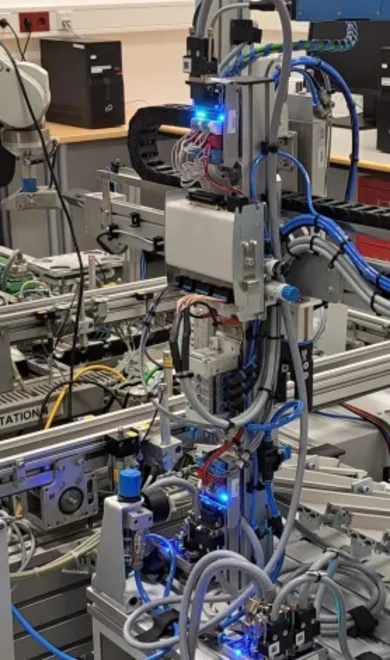
You are studying at Wiener Neustadt University of Applied Sciences Campus 1. Directly opposite, covering an area of around 1,700 m², is Area27, the HWN’s TechSpace. This is where all the technical laboratories are located, including, in particular, the Robotics and Automation Technology Laboratory, which is equipped with state-of-the-art facilities. In addition, you’ll have access to the Innovation Lab, a public makerspace with dedicated areas for robotics, electronics and 3D printing. This means you’ll be closely connected to practical work and research at the Wiener Neustadt Technopol right from the start. Furthermore, in the first semester, teaching takes place one day a week at the FabLab at HTL Mödling.

The degree programme opens up career prospects in the following areas:

On the Bachelor’s degree programme in Robotics & Artificial Intelligence, you’ll be working with a variety of robotic systems and the latest industrial technology right from the start. In the state-of-the-art laboratories at Area27, you’ll have access to specialised software and a wide range of robotic systems for projects, practice classes and research work. This allows you to gain practical experience whilst still studying with technologies that are also used in companies and research institutions.
You will programme state-of-the-art robotic arms and design automated robotic cells – that is, production areas in which robots, sensors and machines work together.
You develop autonomous systems that recognise their surroundings, orientate themselves and navigate independently.
You will learn how people and robots work together safely and efficiently with the help of collaborative robotics.
Using cameras, image processing and artificial intelligence, you teach robots to perceive their surroundings and react to them.
You’ll also have access to the HWN Innovation Lab, which is equipped with 3D printers, laser cutters and electronics workstations. There, you’ll develop, build and test your own projects and prototypes. You’ll also work at the HTL Mödling FabLab.
Rubik’s Cube – A robot solves the Rubik’s Cube
Can a robot solve a Rubik’s Cube on its own? Robotics student Amin Same has achieved just that. In collaboration with ABB Robotics, he programmed a collaborative robot that recognises the colours of the Rubik’s Cube and performs the necessary rotational movements.
A particular challenge was ensuring reliable colour recognition under varying lighting conditions. The movement sequences also had to be programmed so that the robot rotates the cube precisely without damaging it.
The project demonstrates how image processing, programming and collaborative robotics work together to solve complex tasks.
Project lead: Robotics student Amin Same
Partner: ABB Robotics
Duration: 1 semester
"As a technology leader in the field of automation and robotics, we are already thinking today about the innovative solutions of tomorrow. That is why we are a partner of the Robotics & Artificial Intelligence study programme, enabling us to put new ideas into practice."
From an idea to your own robotics project
"Qualified staff and innovative solutions are essential to our company’s success. The study programme enables us to engage with the next generation of engineers and develop solutions for the automotive production of tomorrow."
From an idea to your own robotics project
Mobi – Navigating autonomously and overcoming obstacles
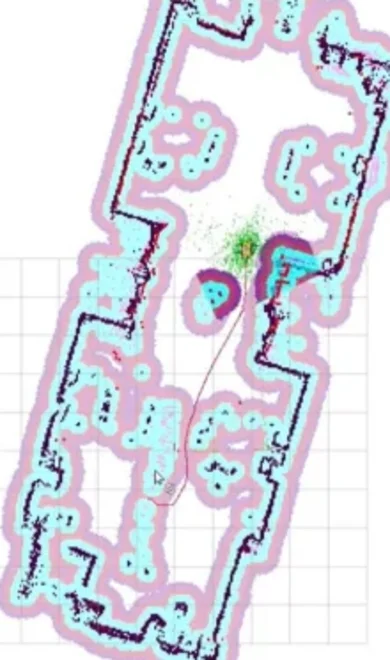
How does a robot find its way round on its own? Mobi demonstrates how autonomous navigation works in practice. Using a range of sensors and intelligent software, the mobile robot maps its surroundings, determines its position and navigates independently to defined destinations.
In doing so, Mobi detects obstacles in real time and automatically avoids them. The combination of modern sensor technology, precise localisation and intelligent navigation systems enables safe movement in a variety of environments.
The project illustrates how autonomous robotics can be used to make processes more efficient and to open up new applications across various industries.
"The use of robotics enables ZKW to manufacture competitive, high-quality products. Forward-looking companies need highly skilled staff and stable processes in order to operate robots in automation systems to the full."
AI-based quality control – When robots detect faults
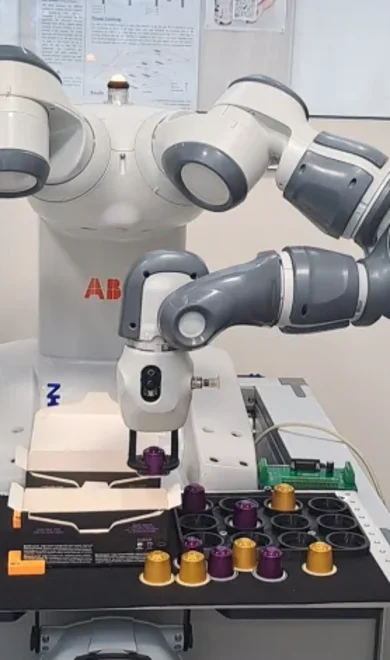
How can artificial intelligence and industrial robots work together to check the quality of products? In this project, students developed an automated system for quality control of coffee capsules.
To do this, they defined quality characteristics such as damage, deformation and colour deviations, and used image data to train an AI model that distinguishes between intact and defective capsules. Depending on the result, an industrial robot carries out the appropriate action. A programmable logic controller (PLC) coordinates the entire process chain – from image capture and AI analysis to robot control. All processes and results can be monitored via a human-machine interface (HMI).
The project demonstrates how AI, image processing and industrial robotics work together in automated quality control.
Cooperation partner: ABB Robotics
Duration: 1 semester
IntelliPro – Intelligent production processes of the future
How can production processes respond flexibly to changing requirements? As part of the IntelliPro research project, the Institute of Industrial Engineering is collaborating with the bachelor’s programme in Robotics to develop a simulator and a demonstrator with the aim of testing and further developing innovative automation concepts.
The focus is on production environments in which product variants, order volumes and material qualities are constantly changing. At the same time, the aim is to enable a high degree of automation and close collaboration between humans and machines.
Funded by the FFG as part of the COIN Aufbau programme, the project strengthens the university’s research capabilities and supports the development of innovative solutions for industrial production.
Project leaders: Mustafa Algan, BSc MSc; Gábor Princz, BEng MEng; Roman Hörbe, BSc MSc
Cooperation partner: Federal Ministry of Labour and the Economy
Duration: 36 months
Teleoperation – Controlling industrial robots with hand gestures
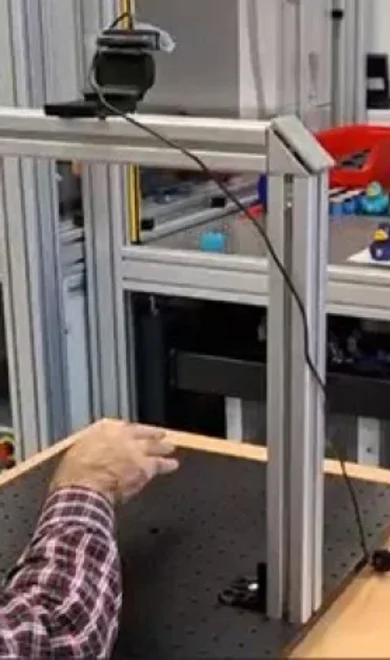
Can an industrial robot be controlled solely by hand movements? In the Teleoperation project, a 6-axis IRB1200 robot was fitted with a soft gripper and controlled using AI-based gesture recognition.
A webcam captures the hand movements, which are then analysed by an artificial intelligence system. A Python programme translates these into precise movement and gripping commands, which the robot executes in real time. Hand movements control the robot’s position, whilst opening and closing the hand activates the gripper.
In a practical test involving 25 participants, the robot had to pick up three rubber ducks at a time and place them in a different position. The average completion time was around 44 seconds, with most attempts being error-free.
The project demonstrates how AI-supported gesture control enables intuitive and reliable collaboration between humans and robots, and highlights the potential this technology offers for industrial applications.
Project lead: Dipl.-Ing. Dr Alexander Nemecek | Mustafa Algan, BSc MSc


















Dipl.-Ing. Dr. Alexander Nemecek
Studiengangsleitung
Kontakt für Interessenten
In the first year of your degree – the 1st and 2nd semesters – you will lay the scientific and technical foundations for your robotics degree. These include mathematics, programming, electrical engineering and mechanics. In addition, you’ll work with modern software tools, such as those used for 3D design (CAD) or scientific computing. This allows you to apply the theoretical content directly in practice and deepen your understanding.
Around a third of the degree programme consists of practice-oriented courses. In addition, from the very start, you will work on a robotics project every semester, in which you will collaborate with other students to tackle specific tasks in the fields of Robotics & Artificial Intelligence.
The projects build on one another in terms of content: you start by designing and programming simple robotic systems and, as your studies progress, develop increasingly complex solutions – ranging from autonomous mobile robots to intelligent industrial robotic systems. You’ll work in the state-of-the-art Robotics and Automation Technology laboratory with industrial robots, mobile robot platforms, camera systems and industrial control systems. In this way, you’ll learn to integrate various technologies into intelligent robot systems and apply them in a practical context.
Artificial intelligence will be a constant feature throughout your degree. Each semester, you’ll deepen your knowledge step by step – from the basics right through to modern AI applications. In the first semester, you’ll gain an overview of the fundamentals of Robotics & Artificial Intelligence. In the second semester, you’ll learn how to analyse and evaluate data. Building on this, in the third semester you’ll explore databases and machine learning. In the fourth semester, you’ll develop and train neural networks. In the fifth semester, you’ll deepen your knowledge in the ‘Deep Learning’ course and analyse complex AI applications. The programme concludes in the sixth semester with an examination of ethical and legal issues surrounding the use of artificial intelligence.
No, you don’t need to be a robotics engineer just yet to become one! An interest in maths and some prior knowledge of programming are recommended, but not essential. The degree programme begins with the fundamentals of maths, programming and Informatics, and builds on these step by step. What’s important is an interest in technology and a willingness to familiarise yourself with mathematical and technical topics. A C1 level of German is required for admissions.
The internship in the 6th semester lasts at least 12 weeks, with 30 hours per week. You will work on a specific project within a company, whilst receiving supervision from the university. Your bachelor's thesis will be based on this topic.
Yes. In the 3rd and/or 6th semester, you can undertake a semester abroad or an internship abroad. For a semester abroad, there are several partner universities to choose from, or you can organise your own semester abroad.
Yes. If you wish to focus on robotics, automation or AI in your pre-university research project (VWA) or degree thesis, we will support you free of charge with the practical part of your work in the HWN robotics laboratory. Possible topics range from ‘How does AI work and what applications are there in everyday life?’ to robots in medicine, a gesture-controlled mobile robot or a cycle time-optimised pick-and-place application. Relevant school subjects include, amongst others, Informatics, automation technology, physics and descriptive geometry.