


What is it like to study mechatronics?
Additive Manufacturing Specialisation in the Master’s in Mechatronics
Lighter, more functionally optimised, more complex: additive manufacturing opens up new possibilities in product development. In the Additive Manufacturing specialisation, you will learn to develop products for 3D printing right from the start – using Design for Additive Manufacturing, topology optimisation, modern materials and quality assurance. You will be involved in the entire process, from design right through to the finished component.

Find out more about the specialisation.
Specialisation content
ContentThis is what you’ll learn in the Additive Manufacturing specialisation
You will learn how components for additive manufacturing are designed, manufactured and optimised in terms of their properties – making them lighter, more material-efficient and geometrically more complex than those produced using traditional methods.
-
Applying additive manufacturing technologies
You assess the possibilities and limitations of various methods and select the most appropriate ones for the specific application.
-
Developing components for additive manufacturing
You will design structures specifically for additive manufacturing processes and improve weight, material usage and functionality through topological optimisation.
-
Applying bionic principles
You apply design principles drawn from nature to technical components and develop innovative lightweight structures.
-
Selecting materials in a targeted manner
You will assess how materials influence the properties, load-bearing capacity and potential applications of additively manufactured components.
-
Characterising materials and surfaces
You analyse the quality, structure and performance of components and optimise them through appropriate post-processing.
-
Ensuring quality and processes
You will evaluate processes and ensure reproducible results and the quality of additively manufactured products.
Study programme for the specialisation
1. Semester
Course
ECTS
- Additive Manufacturing Technologies (MEL)*
- Component Design & Optimisation I (MEL)*
- Electrical Drive Systems
- Measurement Systems & Sensors
- Control Engineering
- Simulation & Modelling
- Materials for Additive Manufacturing (MEL)*
2. Semester
Course
ECTS
- Automation and Robotics
- Component Design & Optimisation II / Bionics (MEL)*
- Data Analysis/Data Management
- Material Characterisation Methods (MEL)*
- Material & Surface Modification (MEL)*
- Methodological Development of Integrated Systems
- Optimisation of Manufacturing Processes (MEL)*
- System Identification
3. Semester
Course
ECTS
- Occupational Health & Safety (MEL)* (WP)*
- Component Design & Optimisation III / Project (MEL)*
- Cosimulation and Hardware in the Loop
- Life Cycle Management (MEL)*
- Management of Design Processes
- Master Thesis Seminar 1
- Quality Assurance & Control (MEL)*
- Legal Aspects & Standards (MEL)*
- Risk Management & Decision Making
- Economic Analysis of Engineering Projects
4. Semester
Course
ECTS
- Master's Thesis
- Master's Thesis Seminar 2
*Compulsory elective subject
Tools & Methods
ContentWhat tools and methods do you use in the Additive Manufacturing specialisation?
-
Design software (CAD)
Designing complex components and geometries specifically for additive manufacturing processes
-
Altair Inspire
Use material only where it is needed, through topological optimisation, and develop lightweight structures
-
Design for Additive Manufacturing (DfAM)
Making the most of the design possibilities offered by 3D printing
-
Material characterisation
Assessing how materials influence the behaviour, load-bearing capacity and service life of components
-
Quality and testing methods
Evaluate manufacturing processes, analyse components and ensure reproducible results
Testimonials & information about the study programme
-
-
"My fascination with 3D printing drew me to the university of applied sciences, and the course content really won me over. The Master’s degree and the specialisation provide a comprehensive insight into mechatronics. I would definitely recommend it!"
-
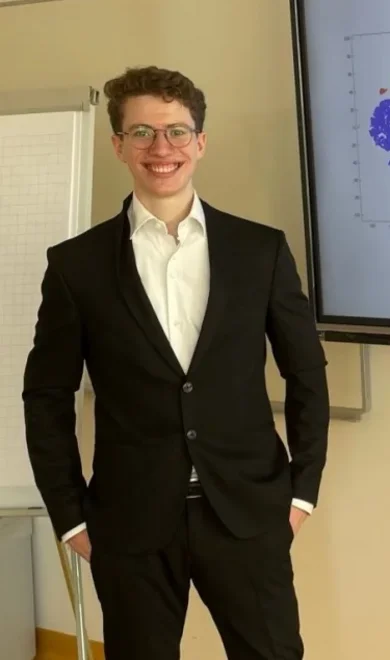
From an academic point of view, I am impressed by the lecturers and must say that their lectures are also very well structured and easy to follow. From an administrative point of view, I would say that the degree programme is very well organised; updates and news are communicated very effectively, and emails are usually replied to on the same day or the following day, both by the head of programme and the administrative office. All in all, I’m delighted to be able to call myself a graduate and alumnus of the FHWN!

Careers
ContentCareers: These careers are open to you once you have completed your specialisation
On the Additive Manufacturing Master’s programme, you’ll be working at the interface between design, materials and production.
Typical roles include:
- Additive Manufacturing Engineer
- Design Engineer (Design for Additive Manufacturing)
- Materials engineer
- Quality Engineer
- R&D Engineer
In addition, opportunities are available in research and development, project and process management, and technology and innovation management.
Contact & personal advice
Content
To make sure no questions remain unanswered, please feel free to contact us!
-
Prof. (FH) Dipl.-Ing. Wolfgang Haindl
head of programme
-
Contact details for prospective students

