
Josef Ressel Centre ResTex
The Josef Ressel Centre ReSTex | Recovery Strategies for Textiles at Wiener Neustadt University of Applied Sciences is developing processes to separate cotton and polyester from blended fabrics in an environmentally friendly manner. The aim is to recover high-quality raw materials and conserve resources. The centre is funded by the Christian Doppler Research Association and works closely with partners from academia and industry.

ReSTex at a glance
-
Duration
2023–2028
-
Management
-
Team
20 project team members
-
Funding
Christian Doppler Research Society
-
Research sites
HWN Tulln and HWN Wieselburg
-
Corporate partners
Salesianer Miettex GmbH
, Starlinger & Co GmbH
, EREMA Engineering Recycling Maschinen und Anlagen GmbH -
Research partners
Vienna University of Natural Resources and Life Sciences (BOKU)
Vienna University of Technology
Just 1 per cent is recycled into textiles
Global textile fibre production amounts to around 134 million tonnes annually. This is equivalent to the production of 100 billion garments. However, the recycling rate within the textile cycle currently stands at only around 1 per cent, simply because the necessary technologies are lacking.
The Josef Ressel Centre ReSTex is developing processes to separate cotton-polyester blended fabrics in an environmentally friendly way. This enables high-quality raw materials to be recovered, resources to be conserved and the circular economy in the textile sector to be strengthened. In this way, ReSTex makes an important contribution to the implementation of the Clean Industrial Deal and to strengthening the competitiveness of its Austrian partner companies.
Cotton + polyester → separation → high-quality raw materials → new uses
Frequently Asked Questions
What is a Josef Ressel Centre?
A Josef Ressel Centre is a technical and scientific research facility at an Austrian university of applied sciences, where the university and businesses carry out joint research over a period of several years. The research questions stem from the business sector, and companies gain direct access to research and development at the university. The centres operate for five years. The costs are shared between the Federal Ministry for Economic Affairs, Energy and Tourism and the participating companies. Supervision of the programme is provided by the Christian Doppler Research Association.
Which research partners are involved in ReSTex?
The University of Natural Resources and Life Sciences, Vienna, and the Vienna University of Technology are involved in ReSTex through a total of four research groups.
Vienna University of Natural Resources and Life Sciences (BOKU)
- Institute of Chemistry of Renewable Raw Materials: Prof. Thomas Rosenau
- Department of Agricultural Biotechnology (IFA Tulln), Institute of Environmental Biotechnology: Prof. Georg Gübitz
- Department of Agricultural Biotechnology (IFA Tulln), Bioplastics Technology: Assoc. Prof. Andreas Mautner
Vienna University of Technology
- Institute of Process Engineering, Environmental Engineering and Technical Biosciences: Senior Scientist Andreas Bartl
How is ReSTex’s research integrated into university teaching?
As part of the ReSTex project, two PhD theses are being written, and a postdoctoral researcher and, to date, ten Master’s students are also involved in the project.
Nika Depope, under supervision at TU Wien, is developing a green solvent for separating polyester from cotton, for which a patent application has been filed. Jeannie Egan, under supervision at BOKU Tulln, is researching how cotton can be separated from polyester using enzymes. Felice Quartinello is a postdoctoral researcher on the project; he provides supervision to students and is working on more efficient enzymes.
How is ReSTex integrated into HWN Tulln?
ReSTex is embedded within the scientifically and economically dynamic environment of HWN Tulln. The site forms part of the ‘Renewable Raw Materials’ Centre of Excellence and is closely linked to the ecoplus activities at the Technopol site in Tulln.
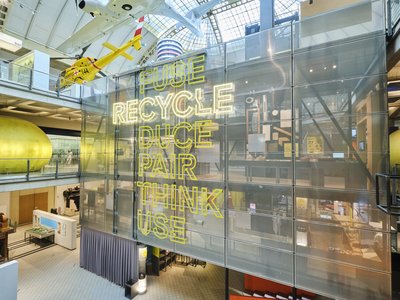
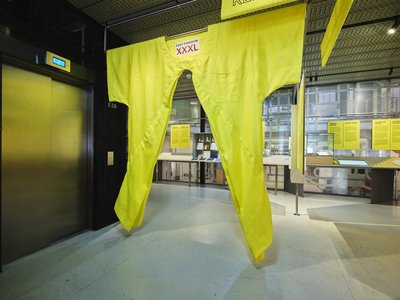
‘More Than Recycling’ exhibition at the Technical Museum
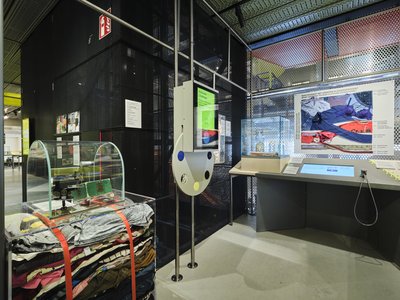
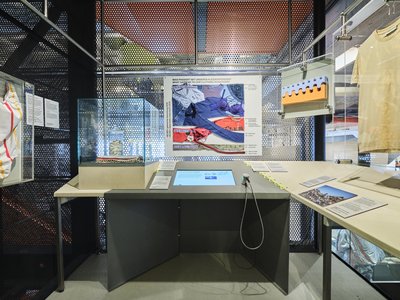
The Josef Ressel Centre ReSTex | Recovery Strategies for Textiles is featured in the ‘More Than Recycling’ exhibition at the Vienna Technical Museum. On display are mechanically recycled polyester fractions from cleanroom clothing, as well as recycled polyester granulate derived from them. These exhibits have been provided by the project partners: the Salesian Group, Starlinger & Co GmbH and the EREMA Group.
The exhibition illustrates key technologies from the ReSTex project, including spectroscopic methods for identifying textile fibres and the use of artificial intelligence for sorting and analysis. The exhibits on display provide an insight into innovative approaches to textile recycling and demonstrate the potential of new recovery strategies in the context of a sustainable circular economy.
The ‘More Than Recycling’ exhibition can be seen at the Vienna Technical Museum until the end of 2026.
-
© TMW/Sebastian Weissinger -
© TMW/Sebastian Weissinger -
© TMW/Sebastian Weissinger -
© TMW/Sebastian Weissinger









-
Dipl.-Ing. Dipl.-Ing. Dr. Christian Schimper
Head of the Josef Ressel Centre
